The designer
Chaparral
0 for sale
Chaparral is the yard in this segment whose accounts are a public document about boats. Sea Ray's owner files with the SEC too, but Brunswick's numbers are mostly an engine company's; when Marine Products Corporation reports, it is reporting Chaparral and its sister brand Robalo and nothing else. That arrangement is itself the founding decision. RPC spun the boat business off on 28 February 2001, handing shareholders a separate company whose only business was building fibreglass sport boats in Nashville, Georgia — a town Chaparral moved to in 1976 by buying a failed boatbuilder's plant, and has not left since. No conglomerate has bought it, no private equity house has parked it, and it has never had to explain itself to a parent with other priorities. The price of that independence is that it must explain itself to everyone, four times a year.
What the company does with the independence is stay put. Chaparral is still, by its own regulated filings, an industry leader in American sterndrive boats from twenty-one to thirty-four feet, in a decade when most of its rivals walked their ranges onto outboard brackets and left. The engineering signature is equally stubborn: the Extended V-Plane, a running surface carried aft of the transom so the vee keeps working behind the boat. Boating's test of the 21 SSi with a 240 hp Volvo Penta sterndrive had it at about 47 mph and onto plane in under four seconds on twenty degrees of transom deadrise, and the reviewer spent as much space on what a sterndrive leaves behind — an unbroken swim platform that becomes the place everybody sits at anchor. The same hull now also comes with the engines outside it, which is the yard's concession to where the market went:
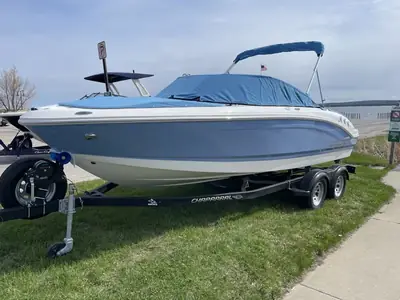
Which matters because the recent numbers are grim, and they are the company's own. Net sales fell 38.4 percent in 2024 on a 40 percent collapse in unit volume, and the first quarter of 2025 fell another 15 percent on a 19 percent drop in boats. The dealer network behind those boats is about 202 US dealers, 155 of whom sell Chaparral — 64 of them exclusively, the rest alongside Robalo. None of that is a verdict on the hull you are looking at. It is a verdict on the segment it belongs to, and a used buyer should read it as a resale forecast rather than a quality warning — the boats built into a contracting market will be competing, second hand, with the unsold ones.
The quality warnings exist and they are unusually easy to check. In 2006 the Coast Guard recorded a recall covering 2,869 Chaparrals of the 2006 and 2007 model years — the 210 and 215 SSi, the 236 SSi, the 256 SSX, the 232 and 236 Sunesta among them — because a fuel fill fitting could crack and let fuel into the bilge; it opened that September and did not close until September 2008. And on the iboats forum in 2023, a thread titled to say quality control had gone collected the sort of complaint that follows: an owner of a new 280 OSX reporting loose and missing screws, stacks of washers used to hold seats up, vinyl scraped by installation tools, helm screws not fully seated and water getting into the splash well under way; an owner of a 287 SSX with a raw-water pump failure and a no-start at thirty-two hours. Nobody in that thread defended the brand, though several posters put the blame on piece-work assembly across the whole industry rather than on this yard in particular.
Read the two halves together and Chaparral's faults turn out to be the opposite of hidden. The hull tests hard, holds its shape and is not what anybody complains about; the complaints are screws, washers, vinyl and trim — the category of defect a buyer standing on the dock with a torch is actually equipped to find. That is a genuinely useful thing to know about a builder, because it means an hour of your own inspection is worth more here than it is on a yard whose misses are behind the mouldings. It also means the cheap end of the range deserves the hour rather than being excused from it:
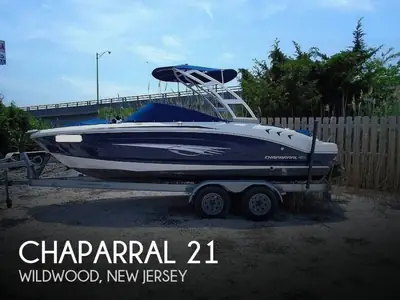
The far end of the same badge is a different proposition again, and it is the part of Chaparral's range that history has been least kind to. A thirty-one-foot sterndrive cruiser was an ordinary thing for this yard to build once, and the filings above describe what happened to that idea:
So buy a Chaparral if you are the kind of buyer who inspects rather than trusts, if you want a sterndrive from the builder least likely to abandon the type, and if you would rather have a company that publishes bad news than one that has none to publish. Buy elsewhere if you need the boat to hold its value in a category its own maker's accounts describe shrinking, or if you are buying new and unwilling to spend the first weekend making a list for the dealer. The sport-boat end of the range sits with its rivals on the bowriders under $50k; ours are the 21 SSi, the H2O and the Signature 310.
Models on the shelf
✍︎ Drafted with AI, directed and reviewed by a sailor — our editorial disclaimer.
💬 The scuttlebutt
Nobody has sung out yet — the floor is yours.
Sign in to join the scuttlebutt → — one Google click, and your words count.
Keep reading
- niche Racing monohulls
- scout preview What $120k of wake boat looks like — a Scout study
- boat 2017 Sylvan Mirage Cruise 8522 LZ Port
- designer Carver Yachts
- designer Four Winns