The model
Corsair Marine F-24
24.2 ft · 1992–2007 · 14 for sale now
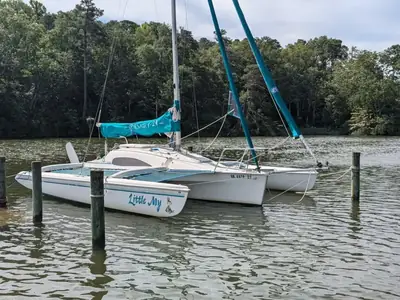
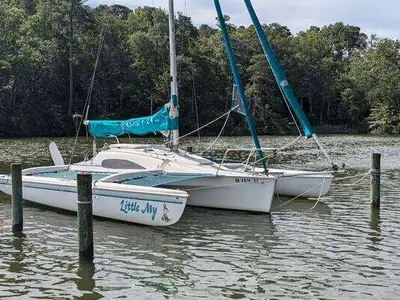
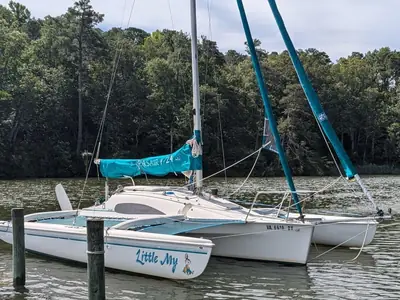
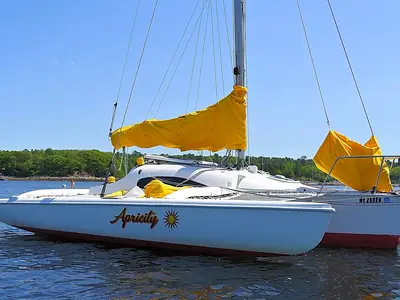
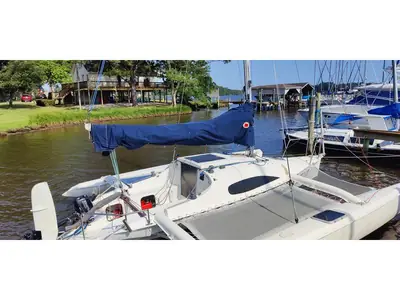
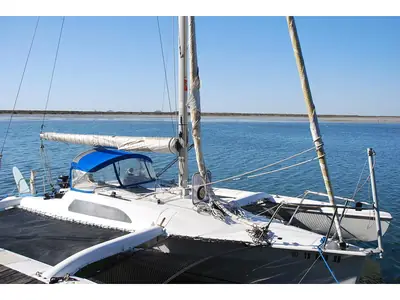
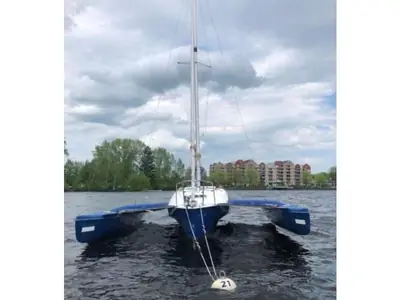
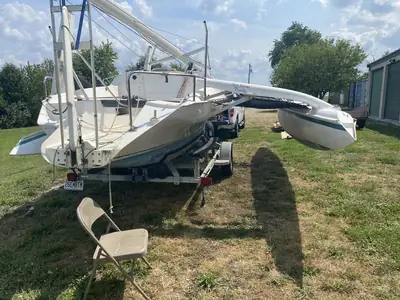
Twenty-four feet is the size people buy in order to be careful. The F-24 is not that boat. It is Ian Farrier's original small trailerable — the one he drew to prove the folding faith did not need 27 feet to work — and it goes about it with 1,800 pounds of foam-cored fibreglass, no ballast whatsoever, and a beam that swings from just under 18 feet down to about eight for the road. Corsair Marine built it at Chula Vista from the early nineties, and about as much boat-per-pound as that decade ever produced is the fair summary. Practical Sailor's verdict is the one to sit with before anything else: not a boat for an inexperienced or a timid sailor, because at speeds approaching 20 knots things happen quickly and mistakes get magnified. Reviewers put the reefing point at 15 to 18 knots of breeze, which on a 24-footer is early.
The Mk I is the centreboard boat. The Mk II that followed traded it for a retractable daggerboard and is rated the quicker of the two and the better to windward; what this side keeps in exchange is a longer cockpit, a more usable cabin, and a kick-up board that costs you nothing but dignity when you find a sandbar. Both came off the same hull and crossbeams, and so, at some distance, did everything Corsair sells today.
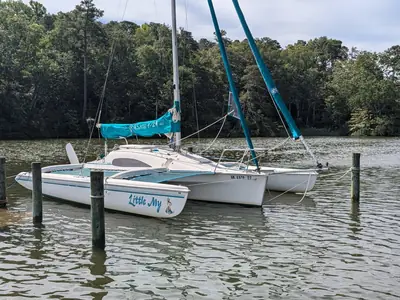
The honest notes start with the laminate, because these are thirty-year-old boats now. Practical Sailor's long-term reports describe failed bedding and damage to the balsa core, gelcoat cracking on the centre hull, and voids in the bows of the floats; where an aluminium board and rudder have lived in salt water, corrosion is the thing to go looking for. Under power she is slow — a small outboard moves her at five to six and a half knots, and pushing through short chop is not what any of this was designed to do — and the motion is quick and jerky in a way owners either enjoy or quietly resell.
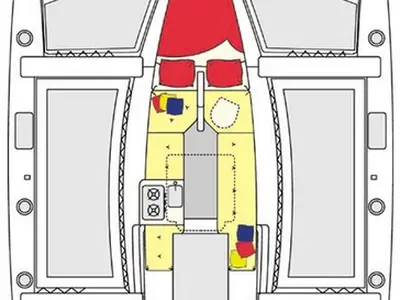
Below, 24 feet is camping, not cruising. The main hull is barely over six and a half feet wide at its widest, there is no standing headroom, the V-berth is too small for two adults, and the head is a porta-potty that gets moved out to the cockpit at night. Corsair itself advised against offshore passages in one, whatever has been done in them since. Two adults and discipline, not four and luggage — and when the boat feels small, that is the design working.
When it stops working, the ladder up runs through the same yard: the Corsair 27 is the next size that still folds and still trails, and the 880 is the modern version of the whole argument, with the interior this one refuses to pretend it has. Every boat we hold that folds to road width is on the trailerable trimarans shelf.
Where the Corsair Marine F-24 is for sale
-
 sailboatlistings.comIN THE APP
 -
 themultihullsource.comIN THE APP
 -
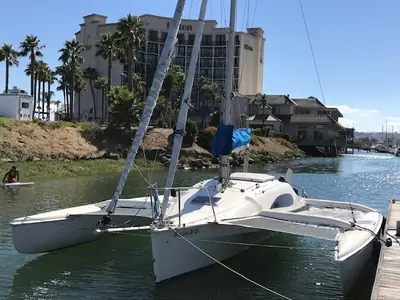 180marine.comIN THE APP
 -
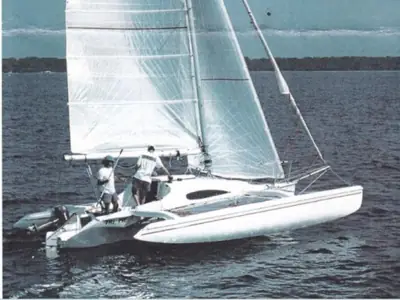 boat24.comIN THE APP
 -
 multihull.nlIN THE APP
 -
 rightboat.comIN THE APP
 -
 yachtr.comIN THE APP
 -
 yachtsite.comIN THE APP
 -
yazuyachting.comIN THE APP
Install the Scout extension and this page shows every live listing for the Corsair Marine F-24 — fetched by your own browser, in your own session. Scout never copies or stores a listing on its servers; it only reads what you fetch, deduped and priced against the Z3stimate.
Add the Scout extensionWhat we hold — open listings
-
1999 Corsair F-24$24,900Scout
-
1996 Corsair F-24$28,000Scout
-
1999 Corsair F-24$26,750Scout
-
1999 Corsair F-24$24,900Scout
-
1998 Corsair F-24
-
2026 Corsair F-24$24,900Scout
-
2002 Corsair F-24$39,500Scout
-
1996 Corsair F-24$27,000Scout
-
1993 Corsair F-24$26,900Scout
-
2003 Corsair F-24$39,000Scout
-
1993 Corsair F-24$28,000Scout
-
Corsair F-24
-
1998 Corsair F-24$45,042Scout
-
1997 Corsair F-24$29,900Scout
Comparable models
✍︎ Drafted with AI, directed and reviewed by a sailor — our editorial disclaimer.
💬 The scuttlebutt
Nobody has sung out yet — the floor is yours.
Sign in to join the scuttlebutt → — one Google click, and your words count.