The model
Farrier F-32
32.9 ft · 2012 · 5 for sale now
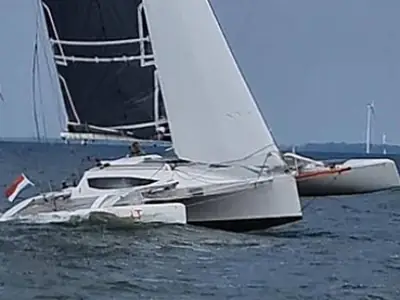
The F-32SR is what an Ian Farrier design looks like when nobody asks it to be reasonable. Take the F-32 folding trimaran, strip the cruising amenities, keep the boat under 2,700 pounds, then hang roughly 800 square feet of upwind sail on it — a sail-area-to-displacement number north of 66, which is not a cruiser's statistic, it's a warning label. The SR is the last stop on a range that runs A, AX, R and RX: the sport racer, carbon options through the boat, a high-aspect daggerboard, a rudder whose case and blade are both carbon. Farrier's own copy for it reads like a disclaimer — a dedicated racer, for experienced sailors only, expressly not a full-time cruiser. And there is no factory behind any of it. The F-32 was sold as plans, and every hull afloat was built to them by a home or professional builder, so the name on the transom tells you which drawing was used and remarkably little about the boat. The folding system still brings her home on a trailer; everything else about her wants a race course.
The shelf is also shorter than the search results, and deliberately so: one hull can wear two advertisements, at two brokers, at two prices, and this family has produced its share of them. Scout folds those into a single boat before the shelf is drawn, which is why counting listings and counting boats are different jobs. What the money end buys, once the doubles are gone, is rig and hardware life on a boat whose loads make both consumable:
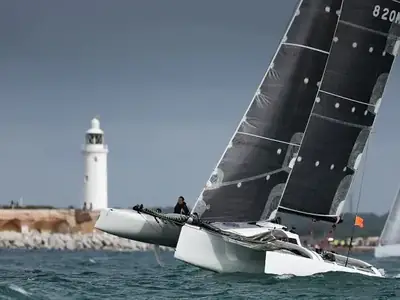
The honest notes start with the thing that has no factory behind it. A survey on this model is less a condition report than an audit of a build: who laid up the hull, to which revision of the plans, and when the beam and float structure was last properly examined. Owners on the F-boat forums have spent years on that subject — cracking around beam bonds and at the outboard beam curve where the shear loads concentrate, reported as hard to see and harder to price — and the F-boat maintenance notes have owners oiling beam-bolt threads and checking the folding pivot pins and their circlips on a schedule. None of that is a reason not to buy one. It is the reason to buy the one with paperwork.
The rest is what SR spells out loud. The comforts stayed on the dock: this is a boat you sail hard and sleep on apologetically. The racing hardware is consumable — budget for it the way keelboat owners budget for antifoul. Resale lives inside a small congregation, and the same specialization that makes her thrilling is what makes her market thin. And the family's own names travel badly through advertisements, so settle which drawing you are standing on from the rig, the boards and the plans rather than from the headline:
If the speed calls but the crew votes for a berth, the folding idea answers with cabins on the folding ocean trimarans, and both ends of that argument sit together on the trimarans for sale.
Where the Farrier F-32 is for sale
-
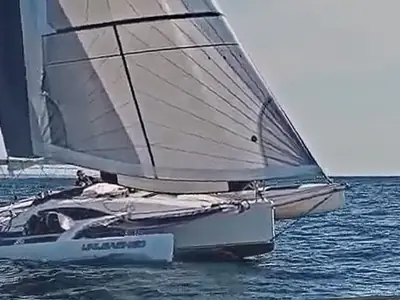 boat24.comIN THE APP
 -
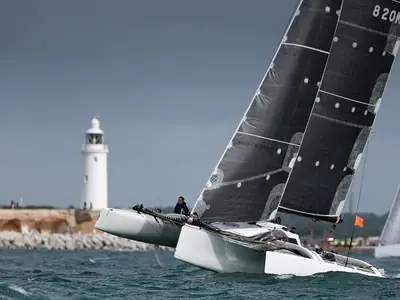 multihullworld.comIN THE APP
 -
rightboat.comIN THE APP
-
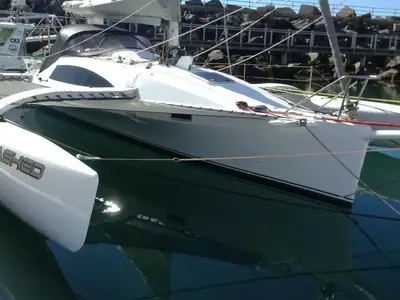 royal-nautisme.frIN THE APP
Install the Scout extension and this page shows every live listing for the Farrier F-32 — fetched by your own browser, in your own session. Scout never copies or stores a listing on its servers; it only reads what you fetch, deduped and priced against the Z3stimate.
Add the Scout extensionWhat we hold — open listings
Comparable models
✍︎ Drafted with AI, directed and reviewed by a sailor — our editorial disclaimer.
💬 The scuttlebutt
Nobody has sung out yet — the floor is yours.
Sign in to join the scuttlebutt → — one Google click, and your words count.