The designer
Cobia
0 for sale
Cobias are built in Fort Pierce, Florida by a company whose other three brands draw a foot of water. Maverick, Hewes and Pathfinder are flats and bay boats, where a pound is a design failure and draft is the entire product, and the Cobia line is what that engineering does when it is pointed offshore. It shows up in two numbers a buyer can check for himself: around twenty-one and a half degrees of deadrise, which is not an offshore boat's number, and a draft near a foot and a half on a twenty-six-footer, which is very much an inshore one. The structure follows from the same habit — hull, stringers, transom and core are infused together in a single pull rather than laid up and then bonded in, and there is no wood anywhere in it, which is a skiff builder's answer to a problem skiff builders met first. So the boat is not a big offshore hull economised down to a price. It is an inshore yard's structural thinking taken up in size, and the compromise in the deadrise is deliberate rather than accidental. The badge is a great deal older than that idea — boats have carried it since the late 1950s, through a spell as a subsidiary of an oil company and a decade in which Yamaha owned the business — but only one date matters to a used buyer. Fort Pierce bought the brand in 2005; anything older than that came out of a different company, and owners of late-1990s hulls report exactly the soft decks you would expect of the era, where wood was used as structure and not sealed against the water that found it.
The cheapest door into the yard is on our shelf now:
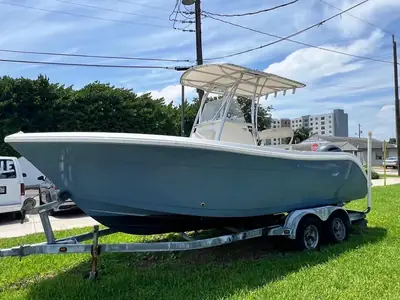
What the independent tests praise about the 220 and its sisters is remarkably consistent, and it is all structure and systems. Sport Fishing clocked the 262 at 53.5 mph, put its best economy at 2.75 miles to the gallon at a 37-mph cruise, and described a comfortable, dry ride in a moderate chop with the forward flare pushing spray down and away. Boating ran a 240 to 51 mph on a single 300 and spent its column on seacocks at the through-hulls, tinned marine wiring, 316 stainless hardware, fully finished lockers and a ten-year structural warranty that transfers with the boat. Then read the same review's list of complaints, because they are the whole argument: transom cleats set high enough for an engine cowling to chafe on them, rod-holder drains that put water onto the pumps instead of into the bilge, and fuel fillers with no splash protection beside the batteries. Not one of those is about the boat. They are about what is screwed to the boat. An owner of a 2021 330 posting on The Hull Truth after a season with it makes the same observation at much greater length and much greater cost — factory caulking cracked and discoloured at four years, fish-box hinges pulling out, a refrigerator held in with quarter-inch screws, a freshwater tank fastened straight into fibreglass — and his own summary concedes the point exactly, that everything on the boat short of the hull had failed him. Posters in that thread argue about whether the corporate parent that bought the yard in 2021 explains it, and the honest answer is that one boat cannot tell you. What the pattern does tell you is where this yard spends and where it saves. The part that is infused in one shot cannot be cheapened without changing the process; the part that is fastened on afterwards is where a middle-of-the-market price gets met, and it is where the second owner finds the yard's decisions. Anyone who wants a boat whose fittings will still be tight in ten years should buy at a price that pays for them, and can start with this yard's corporate sibling at the top of the same ladder, Pursuit. Anyone who wants a properly engineered hull under a fit-out he is willing to maintain — or to upgrade — is looking at one of the better bargains in the center consoles under $100k.
Models on the shelf
✍︎ Drafted with AI, directed and reviewed by a sailor — our editorial disclaimer.
💬 The scuttlebutt
Nobody has sung out yet — the floor is yours.
Sign in to join the scuttlebutt → — one Google click, and your words count.
Keep reading
- designer Hydra-Sports
- niche Pontoons under $50k
- boat 2012 Pogo 12.50
- scout preview Racing sailboats — one question, answered from the whole market
- boat 2022 Cape 31 'Narwhal'