The designer
Hydra-Sports
0 for sale
Hydra-Sports built the offshore fishing boat as one moulded object. The company started making fibreglass fishing hulls outside Nashville in 1973, a long way from salt water, and the house habit that came out of it was to bond the structure into the hull rather than fasten it in: stringers and transverse bulkheads methacrylate-bonded to the shell and then foam-filled, so the grid, the hull and the foam act as one piece. Salt Water Sportsman's test of the 3300 Vector describes exactly that, and then describes what it bought — a boat that stayed dry and stable in a beam sea on the edge of a hurricane, carrying forty rigged rods, with enough compartments that a crew need not haul gear down the dock every morning. That is the whole proposition of the brand at its peak: heavy, deep, bonded, and rigged so completely that the boat is the tackle store. Then the corporate history got in the way of it. Genmar bought Hydra-Sports in 2001, went into Chapter 11 in the recession, and in January 2010 the holding company behind MasterCraft bought the brand out of the bankruptcy for a million dollars, moved the tooling to Vonore, Tennessee and restarted production for the 2011 model year. The Florida operation that had been building the big centre consoles under the same name became HCB Center Console Yachts in January 2018. A used Hydra-Sports is therefore an orphan in the precise sense: the boat exists, the badge exists, and the company that warranted it does not.
Which matters most on the boats from the Genmar years, because the construction the magazine praised is the construction owners fault. On The Hull Truth, owners of the 33 describe a large unsupported area between the stringer grid and the hull shell that was meant to be filled with injected foam and, on these hulls, was not — the foam could not reach the whole void, leaving a span of unsupported laminate that cracks. The accounts go further than a defect: owners report that hulls and whole boats were replaced or bought back rather than repaired, on the reasoning that there is no good repair for it. Set that beside the test report and neither cancels the other. The bonded-and-foamed grid is a genuinely good idea and it is unforgiving of a process that does not complete, and both accounts send a surveyor to the same place — under the sole, along the hull sides outboard of the grid, looking for cracking and for evidence of a hull that has already been replaced. On a boat of this vintage that is not a footnote to the purchase, it is the purchase:
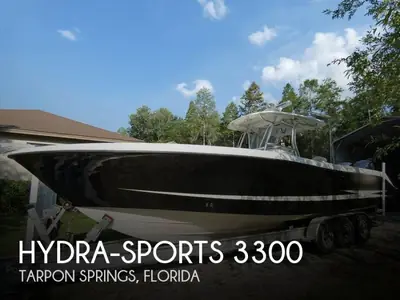
The rest of the honest notes are dated rather than universal. The balsa-cored decks are reported as the weak link on the older hulls and the standard expensive repair. Transom construction moved from timber to a wood-free build partway through the brand's life, so the model year decides whether there is wood in the boat at all, and a 1990s Vector and a 2000s one are different questions on the same subject. Parts are a live problem too: the aftermarket supplies the common items, but a moulded component from a company that dissolved is a fabrication job, and that is the running cost of an orphaned brand rather than a defect in any one boat. So buy one to get a great deal more offshore boat than the money buys new — a heavy, well-shaped hull rigged to fish hard, at the price a dead badge commands. Do not buy one on the strength of the reviews alone: the reviews were written about a boat leaving a factory, and what is for sale now is twenty years of somebody's use plus a structural question that has a right answer and a very wrong one. The design our own boat belongs to is the 3300-3400 Vector CC, and hulls of this size at the affordable end sit with the rest on the center consoles under $100k.
Models on the shelf
✍︎ Drafted with AI, directed and reviewed by a sailor — our editorial disclaimer.
💬 The scuttlebutt
Nobody has sung out yet — the floor is yours.
Sign in to join the scuttlebutt → — one Google click, and your words count.
Keep reading
- designer Mako
- niche Pontoons under $50k
- scout preview What $120k of wake boat looks like — a Scout study
- designer Hunter
- boat 1994 1994 Corsair F-24 Mk 1 $21,900.00 sold out