The designer
Hunter
0 for sale
Hunter is the only yard on this shelf whose rig arrived by way of a singlehanded transatlantic record. Warren Luhrs started the company at Alachua, Florida in 1973 with John Cherubini drawing the boats, handed design to an in-house team under Cortland Steck from 1980, and then went ocean racing himself: in 1984 he won his class in the OSTAR aboard the sixty-foot Thursday's Child, setting a monohull record of 16 days and 22 hours across the Atlantic on a light Bergström rig whose swept-back spreaders did away with runners and checkstays and carried a fully battened mainsail. That rig, drawn by the Swedish aeronautical engineers Lars Bergström and Sven Ridder, is the B&R rig, and what Hunter did next is the house style in one move: it put a racing engineer's answer into a family cruiser and sold it at the family price. The arch over the cockpit, the circular cockpit under it, in-mast furling as standard equipment, the deep roach the backstayless rig exists to carry — this yard bought invention and spent it on the boats people actually buy, which is a different instinct from either of its American or French rivals. Our shelf reaches back far enough to show the moment before it: a masthead sloop with a backstay on it, from the Steck years, at the price of a second-hand car.
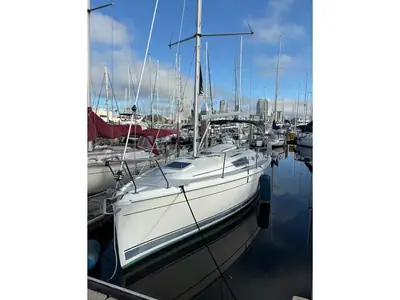
Hunter is also the marque that serious sailors criticise hardest, and the criticism is not folklore. Practical Sailor, sailing a Hunter against a Catalina and a Beneteau, found it the most tender of the three and wrote that the arch still reminded the tester of a Bayliner. Testing a Hunter 310 the same magazine recorded a modest 455 square feet of sail that lacked the oomph to move the boat in light pressure, failing to top three knots reaching; owners in the survey reported a mast that leaked and an indifferently insulated engine box sitting in the middle of the living space; and the verdict included the sentence the whole brand argument turns on, that this is hardly a go-anywhere blue-water cruiser. On the forums an instructor's line does the rest of the work: without a backstay, he wrote, he would not take one offshore.
The defence is in the same magazine, which is what makes it worth reading. Few of the owners Practical Sailor surveyed had even a small beef with Hunter's basic construction; the laminates were hand-laid in good woven roving and knitted fabrics, with four layers of hybrid glass and Kevlar in the high-impact areas and a composite rudder and rudderstock; the circular cockpit was judged to work extremely well at creating space, affording security and promoting comfort; the arch keeps the mainsheet out of the cockpit entirely; and over and over, owners named ease of sailing as the thing they liked most. The magazine's summary was more innovation and function for less money, which is precisely the bargain the yard was offering. Both readings are about the same object, and they collide most usefully at the spreaders. The geometry that let Luhrs's racer dispense with runners is the geometry Practical Sailor watched poke alarmingly into the mainsail when the boat ran downwind. Nobody is wrong. What it costs a buyer is specific: a Hunter is a broad-reaching boat rather than a running one, and on this rig the mainsail is a consumable in a way it is not on a backstayed boat, so the leech, the batten pockets and the spreader tips are where you look on any hull that has done real miles, and a new main belongs in the offer rather than in the following season's budget.
The yard did answer its offshore critics, in the only way a yard can, by building something else. The centre-cockpit Passage 42 put the owner's cabin aft and a proper passagemaking layout under a wing keel and a balanced rudder, and it is the Hunter that people who dislike Hunters tend to make an exception for:
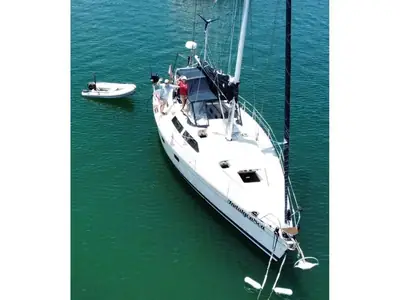
The big 466 and the glazed 41 Deck Salon are the top of what that thinking reached, and they are also where the last part of this page comes due, because the company behind them is gone. The Luhrs Marine Group went into Chapter 11 in April 2012; the powerboat brands stopped, the sailboat plant kept going, and in August 2012 Hunter was sold to David Marlow and became Marlow-Hunter. Owners who visited Alachua in 2019 found the site up for sale with barely anyone in it; the plant was sold to a powerboat builder in 2020; the line drifted down to small boutique daysailers; the moulds were auctioned in 2024 and sailboat production ended in 2025. The clearest evidence of all is that marlow-hunter.com now redirects to an Italian restaurant. That matters to a used buyer in a way it does not on any other yard here: part of what a Hunter's low price always bought was a company standing behind it, and that half has been repossessed. What survives is an unusually good owners' network with ex-factory people in it and a parts trade that runs through it — real support, and not the same thing as a warranty.
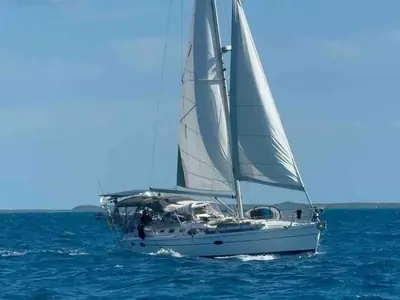
Buy a Hunter if you want the most volume, light and cockpit your money will reach and you intend to use it within a weekend of home, and if the idea of a rig that was engineered rather than inherited appeals to you more than the approval of the marina. The 31 is where that starts cheaply. Buy elsewhere if your miles are dead downwind, if you want a boat a surveyor will call offshore without qualification, or if you need to be able to telephone the builder. The larger boats gather with the rest of the fleet on the liveaboard shelf, and the yard that answered the same question from the opposite end — by refusing to build to a price at all — is Hylas.
Models on the shelf
✍︎ Drafted with AI, directed and reviewed by a sailor — our editorial disclaimer.
💬 The scuttlebutt
Nobody has sung out yet — the floor is yours.
Sign in to join the scuttlebutt → — one Google click, and your words count.