The designer
Mako
1 for sale
Mako is a brand its own owners date. Robert Schwebke started Mako Marine in Hialeah in 1967 and built a reputation on heavy, deep-vee, spartan fishing hulls; Hurricane Andrew flattened the plant in 1992 and the insurance claim was refused; the company went public in 1994, the founding family lost control of it in 1995, and on 16 January 1997 Mako became part of Tracker Marine Group, now White River Marine Group, where it still is. The reason that sequence matters more than most company histories is that the owners themselves built a wall across it. The largest independent gathering of Mako owners calls itself ClassicMako, and the name is the argument: the good years there are reckoned from the late 1970s to about 1990, and 1996 is treated as the end of an era rather than a change of ownership. Anyone selling a Mako is selling into that belief, and anyone buying one has to decide whether he shares it.
The case against the old boats is made by the people who love them, which is what makes it credible. The recurring counsel on the classic hulls is that it is hard to find one whose original wood stringers are not damp somewhere, that transoms on twenty-to-thirty-year-old hulls should be assumed suspect until proven otherwise, and that the deck over the fuel tank is the panel that hides the worst of it. The first boats built with the Euro transom get a harder verdict still — too little structure behind the engines, and cracking common enough to be expected. A classic Mako is therefore not a cheap boat that needs tidying; it is a restoration with a hull worth restoring, and the difference between those two sentences is five figures.
The case for the modern ones is made by people with no stake in the nostalgia. Salt Water Sportsman tested the 284 and read it as a return to the brand's roots — a no-nonsense rugged performer, 52-degree bow entry, 21 degrees of transom deadrise, 4,250lb dry, 52.2mph on twin 250s — and the only fault it raised was noise from a power-steering pump mounted on the console, which the yard then moved. BoatTEST got 55.9mph out of the same hull on twin 300s, liked the joystick docking enough to describe crabbing sideways onto a seawall with it, and complained about an undersized windshield and the geometry of the footrest, calling the boat an evolutionary update in if-it-ain't-broke thinking. Those are small complaints about a competent boat. But the same review that praises it says in as many words that whether the brand recaptures its old loyalty remains an open question — which is the collision, and it is not about fibreglass at all. The boat tests well and the badge is still being argued about, and a buyer pays for both. This is what the modern half of the brand looks like:
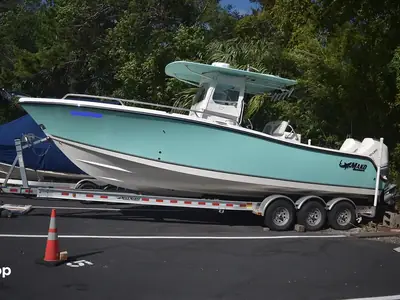
photo & listing at the broker ↗
Scout watches 9 live Mako askings, averaging $105,399; what we publish covers 1 of their models, asking $166,700 across 2020. That average is spread across sixty years of a badge that has meant two quite different things, so it describes the mix on the market rather than the price of a Mako — the useful question is never what a Mako costs but which Mako it is.
There is a third era between the two, and it has its own reported character: owners on the classic forums generally allow that Tracker built the boats carefully through the early 2000s and reckon the cost-cutting started around 2006, which is a claim from an interested party about a competitor's stewardship and should be weighed as such — but it is consistent enough across the archive to be worth a harder look at hardware, hatches and rigging on hulls from that window. Buy a pre-1997 Mako if you want the hull the reputation is about and you can either do laminate work or pay for it without flinching; the boat will outlive you and the wood in it will not. Buy a recent one if what you want is a current offshore-capable centre console with warranty, parts and a dealer within driving distance, and let the nostalgia go — you are buying White River's boat, which the press rates well, not Schwebke's. What you should not do is buy the badge and hope the two are the same thing. The design our own boat belongs to is the 284 Center Console; the older hulls, where most of this brand's history actually sits, turn up on the center consoles under $100k and among everything else we hold under power on the powerboat shelf.
Models on the shelf
Latest on the market
✍︎ Drafted with AI, directed and reviewed by a sailor — our editorial disclaimer.
💬 The scuttlebutt
Nobody has sung out yet — the floor is yours.
Sign in to join the scuttlebutt → — one Google click, and your words count.
Keep reading
- boat 2023 Cobalt Boats 23Sc
- boat 2003 Catalina Yachts 310
- designer Hunter
- niche Cabin cruisers under $50k
- scout preview What $120k of wake boat looks like — a Scout study