The designer
Scout
0 for sale
Scout Boats, of Summerville, South Carolina, spends its money at both ends of what a buyer can see, and the two halves of that decision are what the brand argues about with itself. At the invisible end is a laminate almost nobody else in production boatbuilding uses: closed-mould epoxy infusion, with carbon fibre and Kevlar drawn into the hull and bonded to a structural grid, a process the composites trade press has put at under one per cent of marine manufacturers. At the visible end is everything the yard is actually recognised for — real glass windshields, hardtops that belong to the console rather than bolt to the deck, digital switching, a forward seating station that won an innovation award, and lately outboard boats of fifty-three and sixty-seven feet carrying five engines on the transom. Steve Potts started this in 1989 with a reported fifty thousand dollars and an old brick building, turning out fourteen- and fifteen-footers, and had it flattened by Hurricane Hugo in the same year; the company he rebuilt runs a thirty-four acre campus with several plants and something like five hundred people, and is still the family's — Potts moved up to chief executive in 2022, a son runs product development, and Potts has said in the trade press what he thinks happens to a boat company's drive and focus when a publicly traded corporation takes it over. A yard that pours epoxy into a part no owner will ever look at, and glass into the part every owner looks at first, will be read by the market as two different companies. It is, and the forums are where you can watch people arguing about which one they bought.
The boat we hold is the middle of the line the yard is known for:
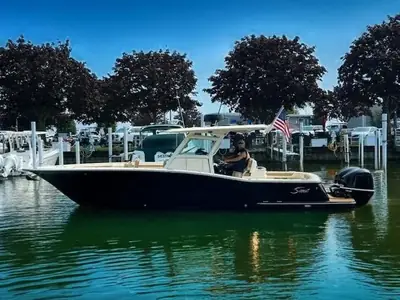
Independent testers of the 320 LXF and its sisters report the same two things: the numbers, and the silence. Boating found the hull stable and easy through the transitions in that chop; Sport Fishing, on the 330 above it, went out of its way to note nary a creak or rattle from an epoxy-infused boat under way, which is precisely the observation that expensive laminate is supposed to buy. The owners' record is louder and much less tidy, and the most useful thing in it is a date. The complaints that come up again and again on The Hull Truth — hull problems described there as well documented from 2000 to 2005, screws backing out of consoles and fittings, voids beneath the gelcoat and gelcoat brittle enough to chip, a 2005 sportfish with delamination in the transom, swim platforms separating and engine bolts working loose — sit overwhelmingly on boats built before this yard's laminate became the thing it sells. That reading defends the modern boats and it should worry a bargain hunter, because the cheapest examples on any brokerage are from exactly that window. Newer complaints exist and are narrower: an Abaco 242 whose cockpit floods when two men stand aft, with two other owners of the model saying the same; an owner who found his smaller boat from this yard falling apart under three hundred hours, and a dealer who would not help him. Against all of it, in one of those same threads, sits a surveyor quoted as saying these were among the least problematic boats he surveyed — and in another, one man calls the yard all glitz and the ride wet while an owner of the model next to his says it rides well and stays dry. Nobody is lying. A hull with a convex variable-deadrise bottom and a lot of flare will feel different to two people running it at different trims in different water, and a yard that has been visibly rebuilding its own construction for twenty-five years will have owners whose boats came out of different decades of it. So the buyer's work here is dating rather than adjudicating: establish which era the hull is from, then survey the transom and the fasteners rather than the brochure. And know what the premium is actually buying, because it is not only the laminate — glass, digital switching and screens are the parts of this yard's boats that date fastest and cost most to put right, and they are the parts that made the boat feel expensive when it was new. Anyone who wants that money spent on deadrise instead of on joinery should be looking at Regulator. Anyone who wants the most finished thing on the water with real engineering underneath it is at the right yard, and the rest of what we hold under power is on the powerboat shelf.
Models on the shelf
✍︎ Drafted with AI, directed and reviewed by a sailor — our editorial disclaimer.
💬 The scuttlebutt
Nobody has sung out yet — the floor is yours.
Sign in to join the scuttlebutt → — one Google click, and your words count.
Keep reading
- boat 2022 Tricat 30
- niche Pontoons under $50k
- scout preview Racing sailboats — one question, answered from the whole market
- designer Richard Woods
- boat 2013 Four Winns H210 SS