The designer
regulator
0 for sale
Regulator has been selling the same number since 1988: twenty-four degrees of deadrise at the transom, on hulls drawn by one naval architect, built in one small North Carolina town, by a company still owned by the couple who started it. Owen and Joan Maxwell laid up their first boat in a converted A&P grocery store in Edenton. It was meant to come out somewhere between 23 and 25 feet, finished at 25 feet 10 inches, and is why the model that launched the yard is called the 26. Lou Codega has drawn every hull since. What makes that a house style rather than a slogan is what the yard has declined to do with it: no move to a stepped bottom for speed, no cheap end of the range, and a production rate a North Carolina magazine put at around 250 boats a year out of a single plant — a rounding error beside the volume brands a buyer cross-shops. Joan Maxwell gave that magazine the reason in one line: a customer with a problem is not dealing with corporate America, he is dealing with Owen and Joan Maxwell. The interesting hull in the range is therefore the one where Codega broke the yard's own rule.
The rule-breaking hull is the one we hold:
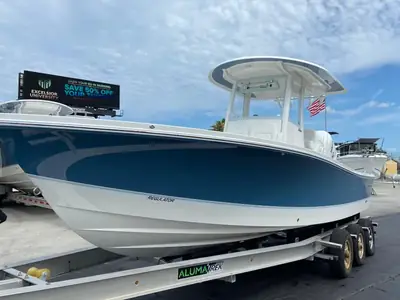
The independent tests of the 26 XO agree on what the trade bought and what it cost. Boating recorded a top end in the mid-40s and a 27-to-32-mph cruise, Salt Water Sportsman had it running dry without pounding through sharp bay chop with six aboard at around 35 mph on roughly 16 gallons an hour, and Sport Fishing summarised the hull as neither a bay boat nor a deep-V. The dissent is in the same reviews rather than against them: one notes it will not split open big waves at speed the way the 24-degree hulls do, another that buyers will want engine options above the base 300, and Boating's one practical warning is that the vent for the transom pocket has to be open under way or a vacuum forms behind the hull and costs performance. The honest notes on the rest of the range come from owners, and they are old, specific and worth carrying to a survey. On the owners' forum and on The Hull Truth, 26s from the middle 1990s — 1996 through 1998 are the years posters name — turn up with the moulded grid unbonded from the hull forward, at and around the fuel tank; getting at it means cutting the deck, and the grid is harder to work on than plain fore-and-aft stringers because it is not laid out that way. Owners report factory involvement in the repairs and more tabbing on later hulls, which is the shape of a defect that was found and fixed rather than one that was denied. A 2002 23-footer went back to Edenton for spider cracking that the factory put down to a bad batch of gelcoat. Trailer buyers report real weights well above the published ones. And an owner of a 28 describes the boat rolling hard enough at rest to be unpleasant — which is not a contradiction of the praise but the same property read from the other end, because a hull with enough deadrise to land softly at speed has nothing much to sit on when it stops. The paper is the last surprise: the yard covers structure for five years and everything else for one, shorter than the ten-year transferable structural cover that mid-market rivals print, and its own warranty page answers the gap by arguing resale value, which is the seller's claim rather than evidence. Anyone who anchors up to swim, tows near the limit of a half-ton, or fishes water that never gets rough is buying deadrise he will pay for twice. Anyone who runs offshore in weather he did not choose is buying the thing the yard has spent nearly forty years refusing to dilute. What the same money buys in older or smaller hulls is on the center consoles under $100k, and the wider fleet on the powerboat shelf.
Models on the shelf
✍︎ Drafted with AI, directed and reviewed by a sailor — our editorial disclaimer.
💬 The scuttlebutt
Nobody has sung out yet — the floor is yours.
Sign in to join the scuttlebutt → — one Google click, and your words count.
Keep reading
- boat 2002 2002 Corsair 28 CC $44,000.00 sold out
- designer PDQ
- scout preview How much center console does $100k buy? — a Scout study
- niche Motoryachts $50k–$200k
- boat 2022 Cape 31 'Narwhal'