The designer
PDQ
0 for sale
PDQ built small catamarans to a standard nobody was applying at that size, and then spent fifteen years watching its customers undo the point of it. The yard started in 1987 in Whitby, Ontario, on the old Whitby Boat Works site, with an MIT-trained engineer, Harvey Griggs, and a designer, Alan Slater, and the brief was a light boat: triaxial knitted glass, isophthalic resin and gelcoat chosen for blister resistance, foam core vacuum-bagged above the waterline and solid laminate below it, keels moulded as NACA foils and secondary-bonded on. The first boat launched in 1989 and was stretched two years later with stern steps into the 36, the model that carried the company — around a hundred built, against roughly a hundred and seventy PDQs of all types. A thirty-six-foot catamaran that displaces eight thousand pounds is the whole argument in one number, and the details all serve it: twin 9.9-horsepower four-stroke outboards tucked under the cockpit seats and tilted clear of the water when sailing, an eighteen-foot beam that fits ordinary marinas, deck hardware that a reviewer found generously sized to the point of looking massive for the boat. None of it was ever aimed at a charter fleet. These were sold to the people who were going to sail them, and the owners' association, its newsletter and its forums have outlived the factory by nearly two decades.
From 1994 the yard offered the same hull as the Long Range Cruiser: inboard diesel saildrives of eighteen or twenty-seven horsepower in place of the outboards, more fuel and water, heavier standing rigging, safety bars at the mast. That option is the yard conceding its own dilemma in public, because every item on that list is weight added to a boat whose entire case is that it does not carry any. It is also the version most likely to be in front of a buyer today:
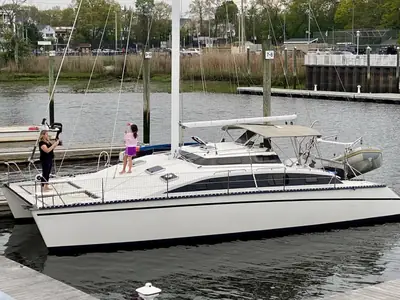
The honest notes start where the weight does, because the two independent reviews of the boat disagree about it in a useful way. Canadian Boating's test found the boat rock solid, heeled about five degrees with a full cup of coffee undisturbed at the helm, tacking through an apparent wind angle of thirty-five to forty degrees — and quoted the yard itself on the problem: customers want refrigeration, pressure water and battery capacity, and it all adds weight, which slows the boat. Sailing magazine's review carries a broker's line that the 36 simply outperforms most of its competitors, then puts the realistic figure at seven to eight knots all round rather than the ten to fifteen the marketing claimed. Both are true of the same hull at different displacements, and the practical consequence is unusual: on this boat the survey question is not only what condition the equipment is in but what all of it weighs, because twenty-five years of additions to an eight-thousand-pound catamaran is the difference between the boat the reviews sailed and the boat on the mooring.
The specific complaints are small and consistent across sources. Two separate reviewers went after the same component — the offset bi-fold smoked acrylic companionway door, described as giving little security against a break-in and as usually leaking in rainstorms by one, and as difficult to secure in a blow by the other. There is no room for a permanently mounted boom vang, so downwind control is improvised with tackle. The deep cockpit that makes the boat feel safe restricts the view forward. Reaching across a swell produces the sharp jerking motion that is every multihull's worst point of sail, and testers wanted more handholds than the boat provides. On hulls of this age the survey items are the ones that always attend a foam-cored deck: moisture and delamination where water has found a way in, and standing rigging that is now well past the age at which anyone recommends replacing it.
The company is the last honest note. PDQ's sailing line went to Argentina in 2003, where the 44 continues as the Antares; the power-catamaran business was bought by Pearson Composites in February 2008; and the yard itself was killed that year not by its boats but by its currency, building in Canadian dollars for customers paying in American ones as the exchange rate moved against it. The mechanical parts are generic and still available — Yanmar, Volvo, Yamaha — but anything specific to the boat comes from other owners or from a fabricator, and that is now the permanent condition of ownership rather than a temporary inconvenience.
Buy one of these to sail a real catamaran shorthanded on a monohull's marina bill, from a yard that spent its money on the laminate rather than on the brochure, with an owners' network that still answers questions. Do not buy one to live aboard with everything a modern forty-footer carries, to take four couples anywhere, or to have a manufacturer to call. The 36 LRC is the version that already made half of those compromises at the factory. The other owners' catamaran from a yard that no longer exists — heavy, slow and built for the same kind of person — is Prout, and the two-hulled fleet we hold is on the catamaran shelf.
Models on the shelf
✍︎ Drafted with AI, directed and reviewed by a sailor — our editorial disclaimer.
💬 The scuttlebutt
Nobody has sung out yet — the floor is yours.
Sign in to join the scuttlebutt → — one Google click, and your words count.
Keep reading
- boat 2006 Formula 370 Super Sport
- boat 1999 Beneteau Oceanus 321
- niche Trailerable trimarans
- designer Corsair Marine
- scout preview Racing sailboats — one question, answered from the whole market