The designer
Prout
0 for sale
The first thing to look at on a Prout is the mast, because it is in the wrong place. It stands well aft of where a catamaran normally carries one, with a small mainsail behind it and a large low-aspect genoa in front, and once that decision is understood the rest of the boat follows from it. Driving the boat off the headsail keeps the load away from the lee bow rather than pressing it down; a small main is one a couple can reef at night without leaving the cockpit; every line leads back to one place. The bridgedeck sits low on purpose, for windage and for the centre of gravity, and beneath it runs the nacelle — a shallow third body that buys headroom inside and lets an inboard engine drive through a retracting leg. The hulls are solid glass below the waterline, the beam is narrow enough for an ordinary marina berth, and the boats are heavy: owners put a fully equipped Prout 38 at six to seven and a half tonnes. All of which describes a catamaran meant to be sailed slowly across an ocean by two people, drawn that way decades before anyone thought of fitting four charter cabins into one. Roland and Francis Prout paddled for Britain at the 1952 Helsinki Olympics and had already lashed two racing kayaks together with bamboo to see what would happen; the Shearwater that came out of those experiments is recorded by the National Maritime Museum as the first production catamaran in the world, and the yard on Canvey Island in Essex built close to 4,300 boats before the doors shut.
The reputation was carried by one model. More than five hundred Snowgoose 37s were built, most of them in the 1980s, and Sailing magazine's review of the type counts nearly a hundred documented circumnavigations among them — a record no thirty-seven-foot production catamaran has any business holding. That generation is still the cheapest way into a boat with an ocean behind it:
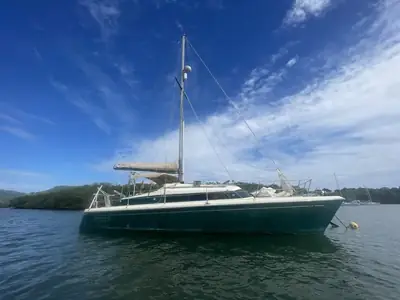
The rig that makes the boat easy is the same rig that makes it slow, and owners argue both halves of that in the same breath. Low-aspect keels and a small mainsail limit how high a Prout will point, the enormous genoa takes a while to get across on every tack, and experienced owners writing on the British sailing forums plan passages at five and a half to six and a half knots rather than at the numbers a broker quotes. In the same threads those owners describe the boat's windward ability as being as good as any other fixed-keel cat and certainly not a dog, and treat the slamming under that low bridgedeck as noisy rather than dangerous — it takes little way off the boat even when it is rough, and the clearance was traded away deliberately for the low rig and the low centre of gravity. Both accounts are of the same boat, and together they say what it costs to find out: plan a Prout passage at six knots, route it with the wind behind, and understand that a buyer whose sailing is mostly upwind in a short chop is not looking at a fault to negotiate but at the design doing what it was asked to do.
The mechanical notes are narrower. On the Snowgoose the single retractable Sonic drive is reported as expensive to repair, which on a one-engine boat is also the get-home question. Build quality moved with the years — a long-standing owner's summary of the fleet is that the early boats were variable and the later ones, the 38 in particular, excellent — and heavily customized examples are described as having come out far too heavy, which on a boat already carrying this much weight shows up first in the performance and then in the waterline. The later hull is the one that answers most of those complaints:
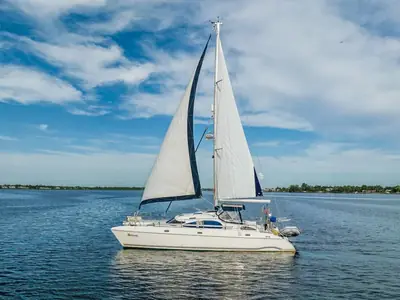
Which leads to the fact that matters most and appears in no brochure: the name outlived the yard and went in three directions at once. The Canadian Quest group bought Prout in July 2000, receivership followed in September 2001, and the UK operation was closed by a telephone call from Canada in February 2002 — staff told to collect their belongings and leave, with a High Court freeze already over the assets because a former chairman feared the moulds would be out of the country before his royalties were paid. In the liquidation the 34, 37 and 39 moulds went to South Africa, the 38's stayed in England and became the Broadblue 38, and the 45's went to Prout International in Hong Kong, which built in Thailand and then China until around 2013. Owners of half-finished boats hired the yard's own redundant staff to complete them elsewhere. So a Prout is not one thing, and the year on the transom tells you which of four propositions you are surveying. The 45 was the prettiest hull they drew, and the 1990s ones are Essex boats:
Buy a Prout to cross oceans shorthanded and cheaply, to carry a great deal of gear without the boat noticing, and to own a catamaran that was designed for exactly that and for nothing else. Do not buy one for speed, for bridgedeck volume, for a modern layout, or if you want a factory standing behind the hull — there has not been one since 2002, and the owners' groups have been the parts department ever since. The other cruising catamaran built for its owners rather than for a fleet, arguing the opposite case from a lighter and quicker boat, is PDQ; the Prouts we hold sit with the rest of the ocean-going fleet on the bluewater shelf and with every other two-hulled boat on the catamaran shelf.
Models on the shelf
✍︎ Drafted with AI, directed and reviewed by a sailor — our editorial disclaimer.
💬 The scuttlebutt
Nobody has sung out yet — the floor is yours.
Sign in to join the scuttlebutt → — one Google click, and your words count.
Keep reading
- designer South Bay
- niche Bowriders under $50k
- scout preview The Gemini question — why the affordable catamaran is always a Gemini
- boat 2018 F32 SRC
- boat 2013 Monterey 260 SCR