The designer
Richard Woods
0 for sale
Richard Woods draws catamarans for people who are going to build them, which turns out to change everything about the drawings. He worked with Derek Kelsall and James Wharram before starting Woods Designs in 1981, and the range that followed runs from eight-foot beach cats to thirty-eight-foot cruisers by way of trailable boats, racers and power cats — sold mostly as plans, close to three thousand sets of them, alongside a couple of hundred boats built to the same drawings by professional yards. Two arguments recur across all of it. The first is bridgedeck slamming, which he treats as self-inflicted rather than inevitable: the water a hull displaces has to go somewhere, it piles up underneath, and a designer who sets the hulls too close together or runs the bridgedeck forward to the bows has built the noise in. His answer is to keep the bridgedeck aft and vary its height along the boat, to use a pronounced knuckle and a flared hull section, and on newer designs to put a shallow V under the bridgedeck instead of a flat panel. Where he breaks his own rule he says so — the nacelle on the smaller boats exists purely to buy standing headroom, so he keeps it to two feet wide and V-bottomed and confines full-headroom bridgedeck cabins to boats of thirty feet and up. The second argument is size, and it is unfashionable: buy the smallest catamaran you need, not the biggest you want, because the generators and watermakers that arrive with the extra feet are the things owners cannot fix, and a boat nobody can fix stays in the marina.
The consequence for a buyer is that a Woods design is a set of instructions, not a product. The same drawing has been executed in strip cedar, in sheet plywood, cold-moulded and in foam sandwich, by a professional yard on one side of the world and a first-time builder on the other, and the difference between the best and worst of them is not a trim level — it is hundreds of kilos and a laminate schedule. A boat like this one is bought on its build, not its badge:
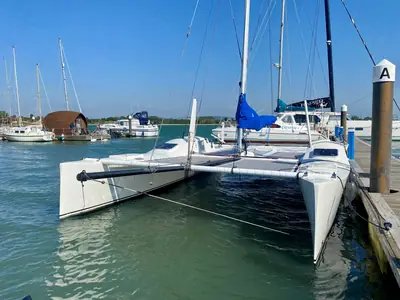
What the world says about the plans themselves is a genuine disagreement, and it is the useful one. Builders on Boat Design Net describe them as high level but thorough, clear and concise, and Woods himself as gracious and quick to answer an email; the author of an independent survey of catamaran designers, who built a Woods Gypsy and cruised it, says just as plainly that there are gaps in the plans when it comes to the interior and the finishing details. He read those gaps as room for his own ideas. A first-time builder should read them as work he will have to design himself, and a buyer should read them as the reason two boats to one drawing have different interiors, different systems and different weights. The same writer supplies the sentence that should govern any purchase of an unfinished project: the boatyards and backyards of the world, he notes, are littered with uncompleted boats which have simply overwhelmed their builders. Cheap hulls are cheap for a reason and the reason is usually the remaining hours.
The second honest note is about ambition, and Woods states it against his own interest. He says the Skua is not really designed for crossing oceans and points ocean buyers at his Saturn or his Gypsy instead — and an owner crossed the Atlantic in one in 2002. Both of those are true, and together they are the whole calculation: the boats are frequently capable of more than the brief they were drawn to, and a buyer betting on that margin is betting on the builder's laminate rather than the designer's intention, which is exactly the thing the paperwork will not tell him. Performance claims want the same care. The speeds quoted for these designs — twelve knots to windward and twenty offwind on the Skua — come from an owner's letter published by the designer, which is a real report from a real boat and also the report a designer chose to publish. Buy a Woods design to get a fast, shoal, demountable catamaran for a fraction of what a production yard charges, and to be the person who knows what is inside his own hull. Do not buy one expecting a survey to be routine, a resale to be quick or a fault list to exist: on a plans-built boat the survey is an audit of one person's workmanship, which is also true of the other architect on our shelf. The design behind our own is the Skua, and the cheaper end of two hulls generally lives on the catamarans under $100k.
Models on the shelf
✍︎ Drafted with AI, directed and reviewed by a sailor — our editorial disclaimer.
💬 The scuttlebutt
Nobody has sung out yet — the floor is yours.
Sign in to join the scuttlebutt → — one Google click, and your words count.
Keep reading
- boat 2006 pogo pogo 40 s1
- scout preview What $120k of wake boat looks like — a Scout study
- niche Bluewater trimarans
- boat 2016 Chaparral 21 H2O Sport
- designer Crownline