The designer
John Shuttleworth
0 for sale
What Shuttleworth has spent a career solving is the same trade every time: how much accommodation can you put on a hull that came out of ocean racing before the boat stops being fast. He set up on his own in 1980 after working with Derek Kelsall, and the two of them were among the first to put computers to multihull design — performance prediction, stability formulae, a rating rule for a class that had none. What followed was fifty-odd multihulls, and the racing half of that list is the part that explains the cruising half: the 65ft Brittany Ferries GB, the 56ft Fleury-Michon VI, the 60ft Great American, the 80ft Novanet, all record boats. His own account of what makes a multihull seaworthy reads as a list of things earned there and then carried across — light structure because lighter means lower loads and lower loads mean less to break; U-shaped underbodies with fine sterns to stop the pitching that buried the bows of the previous generation; forward sections that pick up buoyancy fast above the waterline so the boat lifts rather than dives when it is pressed downwind. The interesting thing about that document is what he concedes in it. Putting a cabin on the bridgedeck costs around a third again in parasitic drag and takes the windward performance with it, and a catamaran carries a smaller stability margin than the equivalent trimaran. He draws cruising catamarans anyway. Every one of them is that concession, priced.
Which is why the name on the transom is a designer's and not a factory's. These hulls were built to plans, by whoever the owner engaged — a composites shop, a yard taking a one-off commission, or the owner himself in a shed. The 35-footer drawn for home building won the Scottish Three Peaks race in 1989; the Tektron 50 was built near Toronto by the man who commissioned it. So two boats to the same drawing are not two examples of one boat in the sense a production buyer means. They are two builds, and the drawing is the only thing they are guaranteed to share. This is one of them:
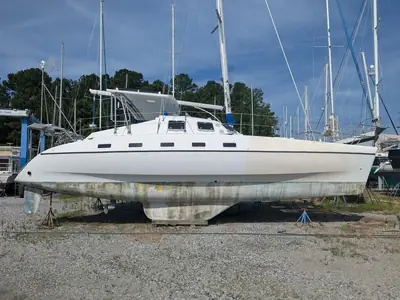
All of which makes the survey on a Shuttleworth an audit of a build, not an inspection of a model, and there is a specific thing to audit. Weight is the whole argument of these drawings, and weight is exactly what a builder can add without meaning to. The builder of a Shuttleworth 32 who documented his project on Boat Design Net put the finished boat on a crane at 5,200lb without the rig and reckoned it maybe four or five hundred pounds heavier than it should have been, blaming the way he had cut and laid the foam and saying he would do it differently next time. That is a candid number from the man who did the work, and it is close to a tenth of the boat — on a hull whose designer argues that lightness is what makes it strong as well as fast, ten percent is not a detail, it is a different boat. Ask what the finished displacement actually was, and be suspicious of any seller who does not know. Ask the date, too: Shuttleworth later offered owners of the earlier 31-footers a retrofit to wave-piercing bows, so a hull's year can move it between two versions of the same idea. And accept what a one-off costs you at the other end. There is no class association, no production run, no fleet of sisters to price against, and an insurer and a surveyor will both charge you for that.
What we could not find is criticism, and that absence is a finding rather than a verdict. Nobody has written up the faults of these boats because there have never been enough of any one of them for the faults to become common knowledge — the strongest critical material available is the designer's own list of what his choices cost and one builder's account of his own mistakes. Buy one if you want a genuinely fast cruising catamaran and are equipped to form your own judgement about a laminate, because that judgement is the purchase. Buy elsewhere if you want a boat whose known problems someone else has already catalogued: the way into that is a production hull, and the other side of the plans trade is where the same question gets asked of a much bigger fleet. What we hold of his work sits with the rest on the catamaran shelf, and the design our own boat is drawn from is the Ocean Cheetah 37.
Models on the shelf
✍︎ Drafted with AI, directed and reviewed by a sailor — our editorial disclaimer.
💬 The scuttlebutt
Nobody has sung out yet — the floor is yours.
Sign in to join the scuttlebutt → — one Google click, and your words count.
Keep reading
- designer Beneteau
- boat 2020 Ranger Reata 220FC
- boat 2021 TRICAT 30
- scout preview The Gemini question — why the affordable catamaran is always a Gemini
- niche Bowriders under $50k