The designer
Beneteau
0 for sale
Beneteau's answer to the cost of a cruising boat is a mould. The yard was industrial before it was ever a yacht builder — a Vendée fishing-boat shop that Annette Roux and her brother André turned over to glassfibre in 1964 and took to the Paris show the following year — and the decision that recurs in everything since is that the boat is drawn so that it can be built. Practical Sailor, putting a Beneteau 311 alongside a Catalina and a Hunter, set the method down in a line: solid glassfibre stiffened by a moulded internal grid, with bulkheads bonded through 360 degrees to hull and deck. The same test called the Beneteau arguably the best finished of the three, and the least expensive. Those two verdicts sitting in one sentence are the whole proposition.
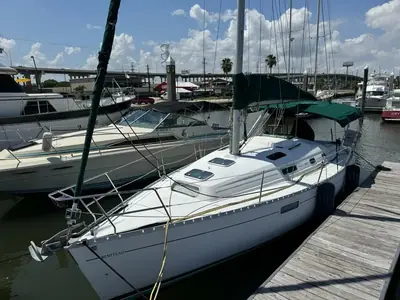
The other half of the house style is that this yard decides what a cruising boat looks like and the rest of the industry follows. The First 30 that André Mauric drew for the 1977 Paris show gave the range its performance half; a plant at Marion, South Carolina in 1990 put French production hulls on American docks; and the shape has moved steadily in one direction since — chines worked into the topsides, beam carried aft to a transom that folds down, two rudders where there was one, the rig further back with the mainsail doing more of the work. Yachting World's test of the Oceanis 46.1 credits the stepped chine with half a metre of extra beam inside the boat and reports twin rudders that never once hinted they might lose grip. Fashion is also how you date a used one, and the boats a buyer can actually afford sit on the near side of all of it — narrow in the stern, one rudder, no chine anywhere:
What the industrial method costs is best read in the one investigation that went looking. In May 2014 the Beneteau First 40.7 Cheeki Rafiki lost her keel in the North Atlantic and inverted, with four men aboard. The Marine Accident Investigation Branch concluded that a weakened structure was the probable cause, and the mechanism it described is the moulded grid itself: inspectors visited four other First 40.7s and found matrix detachment in the bays around and aft of the keel on all of them, all attributed to grounding, with detachment in the forward sections on some of them attributed to slamming. Worse for a buyer, the report noted that the clamping force of the keel bolts can hold a detached matrix in place at the very spot that matters, so the failure need not show. The counter-reading lives on the owners' forums, where Beneteau owners and at least one dealer describe the cracking that appears along the grid edge as cosmetic — a void filled with gelcoat, which is harder than the mastic doing the actual bonding, and which therefore cracks first. Both accounts can be true of different boats, and the MAIB itself directed its recommendations not at Beneteau but at the British Marine Federation, asking for industry-wide guidance on inspecting and repairing matrix-to-hull bonding, and at the RYA, asking that owners be told what a grounding can do. That is the correct address. The grid is not a Beneteau idea, it is how nearly every affordable cruising boat on the water is stiffened, and the question it hands a buyer is the same on all of them: has this hull ever been aground, and who looked at it afterwards. Ask it before the survey, not after, and put the surveyor in the bilge with a hammer around the keel bays.
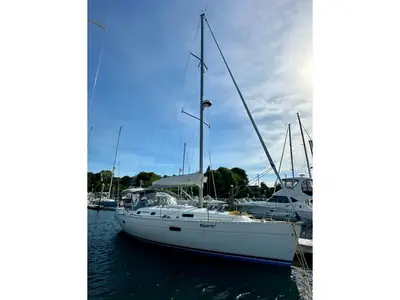
The second thing to know is that the finish and the substance are different budgets. The same Yachting World test that admired the 46.1's hull found bare plywood and liberal amounts of glue in the aft lockers, sole boards missing their gaskets, and quoted the boat's own designer saying that if the finish quality matched the design it would be a very hard boat to beat. That is a yard spending its money where the buyer's eye lands at the boat show, which is a rational thing for a volume builder to do and an expensive thing for the second owner to inherit. The same test put the stowage and tankage squarely in the coastal-and-family-holiday bracket rather than the distance one — and that is the real limit of the type, not the laminate. On a 331 or a 321, the water and fuel you can carry is what decides whether the boat does what you bought it for:
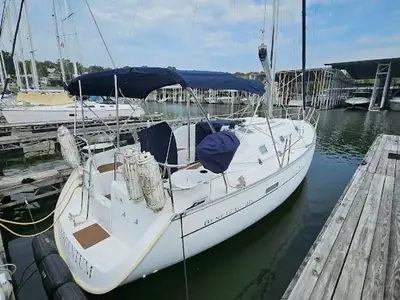
Buy a used Beneteau if you want the most finished, most liquid, most serviceable thirty-something feet your money reaches, and if you accept that being one of very many is the point: parts are ordinary, sailmakers know the rig, and every asking price has a control group. Buy elsewhere if the plan needs tankage and lockers more than it needs headroom and light, or if you cannot get a hull out of the water before you commit, because the one question this method raises is the one that photographs cannot answer. The 361 is where our shelf gets serious about it, the rest of the fleet in this price band is on the monohulls under $100k, and the American yard that answered the same question by keeping the parts instead of moving the fashion is Catalina.
Models on the shelf
✍︎ Drafted with AI, directed and reviewed by a sailor — our editorial disclaimer.
💬 The scuttlebutt
Nobody has sung out yet — the floor is yours.
Sign in to join the scuttlebutt → — one Google click, and your words count.
Keep reading
- boat 2004 Hunter 41
- boat 1996 Lagoon 35 CCC
- niche Center consoles under $100k
- scout preview Racing sailboats — one question, answered from the whole market
- boat 2017 Scout 320 LXF