The designer
Sun Tracker
0 for sale
Sun Tracker's house style is not a hull shape, it is a price tag. Johnny Morris built Tracker Marine around one idea in 1978 — sell the boat, the motor and the trailer as a single nationally advertised package at a number nobody haggles over — and in 1983 he pointed that idea at pontoons. Four decades later the company still prices this way, still puts a Mercury on every transom, still sells through its own outdoor superstores, and still builds in southwest Missouri, where the Bolivar plant that opened in 1988 was expanded to double Sun Tracker output with up to 250 more full-time jobs at full production. Everything a boat like this could argue about has been settled before the buyer arrives: the layout, the power, the price and the dealer. On the pontoons the trailer is the one thing quoted separately, which is worth knowing because it is the part most often missing from a used deal.
That settled-in-advance quality is the useful thing about the brand second-hand, and there is a great deal of it about: more Sun Trackers have been sold than any other pontoon in the country. On a builder where the first owner had almost nothing to negotiate, the spread between two used askings is not a record of what somebody talked a dealer into — it is age, engine and condition, and nothing else. Which is why the engine on the transom moves the money more than anything on the deck:
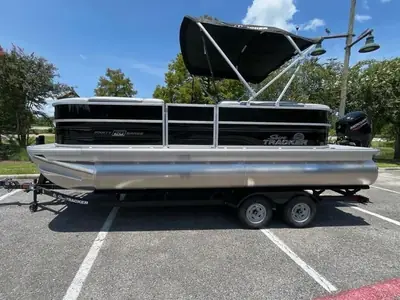
The case for these boats is made by people with instruments, not by the catalogue. Boating's certified test of a current Party Barge 20 DLX ran it to 31 mph, got to 30 in under ten seconds, and found its best cruise at 12.7 mph and 3,000 rpm burning 2.4 gallons an hour — 5.3 miles to the gallon and better than 150 miles of range out of a 32-gallon tank — on a boat that stickered at $35,095 as tested against a $30,995 base. The same testers describe 24-inch logs through-bolted to the deck supports, three-quarter-inch treated plywood under marine-grade woven flooring, and fence rail of inch-and-a-quarter tube with a .09-inch wall. Boats.com, running the bigger Party Barge 24 XP3 behind a 200-horsepower Verado, saw about 40 mph flat out and just over three gallons an hour at a fifteen-mile-an-hour cruise. Nobody who has tested one complains about what it does on the water for the money.
The complaints are all about what happens afterwards, and they are on the public record rather than in anyone's opinion. The Better Business Bureau lists White River Marine Group as unaccredited and carries a pattern-of-complaints alert against it, with 31 complaints filed in three years; the themes running through them are defects and missing parts found at delivery, repairs that run for months without a reply from the company, and warranty claims refused — one filing describes a pontoon used ten times with leaks in both tubes and a lifetime structural warranty initially denied. Complaint aggregators say the same things in the same words: cracked welds, leaks, electrical failures, long waits. That sample selects itself — nobody files with the BBB to report that the boat was fine, and this manufacturer sells more hulls than anyone, so it will always generate more paperwork than a small yard. Both of those defences are fair, and neither of them makes the pattern go away.
The regulator's file is the more neutral read. The Coast Guard's recall database lists dozens of recalls under this manufacturer's code going back to 1981, the great majority of them on the fishing brands and clustering on two kinds of defect — level flotation that failed its test and capacity labels that overstated what the boat could carry; the Sun Tracker entry in that list is a 2009 Party Barge recalled for its capacity label. Separately, in 2022 the company recalled Trailstar and Ranger Trail trailers built from 2020 to 2023 because axle hubs had not been tightened properly and could seize while the trailer was moving. Read the capacity-label history next to a modern pontoon's seating and you get the most useful sentence anyone can hand a first-time buyer: the number of seats and the number on the plate are answers to different questions.
The resolution, for anyone shopping used, is that the brand's documented weakness is largely not their problem. The warranty relationship is what the record faults, and a boat out of warranty has already spent it; what is left is mechanical and checkable. The plywood under that flooring, water standing inside a tube chamber, the welds along the logs, and a trailer that was never part of the price are where a used Sun Tracker is won or lost. Buy one if you want the most seating and the least ceremony for the money and you are content with a fair-weather boat that rides over waves rather than through them. Buy elsewhere if you are buying new and the after-sale relationship is a large part of what you think you are paying for, or if you want any depth of hull under you. The model we have written up in full is the Party Barge 20 DLX, and the rest of the powered fleet is on the powerboat shelf.
Models on the shelf
✍︎ Drafted with AI, directed and reviewed by a sailor — our editorial disclaimer.
💬 The scuttlebutt
Nobody has sung out yet — the floor is yours.
Sign in to join the scuttlebutt → — one Google click, and your words count.
Keep reading
- niche Catamarans under $100k
- scout preview Racing sailboats — one question, answered from the whole market
- model Corsair 36
- boat 2018 F32 SRC
- model Lagoon 42