The designer
Cobalt Boats
0 for sale
Cobalt has the strangest address in American powerboats: the premium runabout, built since 1968 in Neodesha, Kansas — a town of two thousand-odd that sits about as far from either coast as the map allows. Pack St. Clair came home to the southeast corner of wheat country to build boats the expensive way — hulls laid up by hand, Kevlar in the laminate, tooling made in-house, hardware a size heavier than the job strictly requires — and let the price land where it landed, which owners doing the arithmetic on the forums put at roughly double a comparable-length boat with a plainer name.
The used market is the referee of that bet, and it has mostly ruled for the yard: Cobalts hold their price the way the brochure always promised, and the reasons are checkable rather than mystical. Fiberglass stringers arrived from 1994 and composite transoms from 1997, so the rot that decides most old runabouts' fate left these boats decades ago; the customer-satisfaction surveys kept ranking the brand at the top of its class; and the yard once thought its swim step worth a federal case — it sued Brunswick over its retractable-step patent and won, the judgment upheld on appeal in September 2017. That same summer Malibu Boats paid $130 million for the company, then shipping over 2,000 boats a year out of Neodesha. Here is what holding value looks like a decade in:
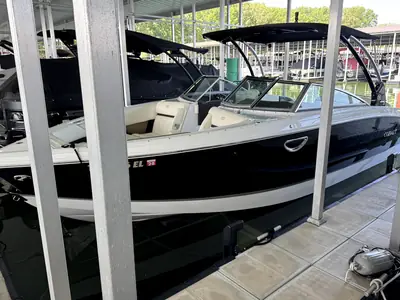
Be clear about what the premium does not buy. It does not buy different machinery: under the sunpad sit the same Mercury and Volvo sterndrives as everyone else's, so an hour meter and a service file outrank the badge every time. It does not buy immunity from trim-grade lapses: owners report rusty screws on new boats, gauges that wander, and aft lockers that will not drain — small things, made loud by the invoice. And it does not reach backward: before 1994 the stringers are wood and before 1997 so is the transom, so a cheap early Cobalt gets surveyed like any thirty-year-old boat. The badge keeps its value; it does not keep the water out. The entry point to all of it:
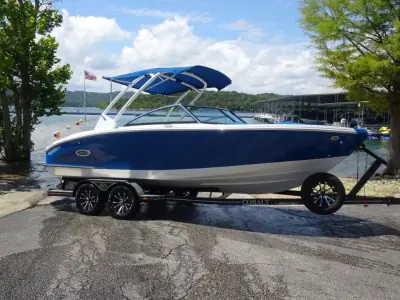
Buy a Cobalt if you plan to keep a boat long and sell it well, and if what you want from a lake day is a solid, quiet, heavy-feeling twenty-something runabout rather than the fastest one. Buy elsewhere if the budget is fixed and the name is the only thing above it — the same money buys a newer or bigger boat in a plainer shirt, and on a freshwater trailer boat that is a sane trade. Ours are the R7 and the CS23; the cheaper end of the same idea queues on the bowriders under $50k shelf, and the whole engine-first universe on the powerboat shelf.
Sources: Wikipedia, Cobalt Boats; the Kansas Sampler Foundation on Cobalt and Neodesha; CobaltChat and iboats owner threads on construction dates and owner-reported defects; GoDownsize, Most-Common Problems With Cobalt Boats.
Models on the shelf
✍︎ Drafted with AI, directed and reviewed by a sailor — our editorial disclaimer.
💬 The scuttlebutt
Nobody has sung out yet — the floor is yours.
Sign in to join the scuttlebutt → — one Google click, and your words count.
Keep reading
- scout preview What $120k of wake boat looks like — a Scout study
- boat 2018 Cobia 220 Center Console
- niche Motoryachts $50k–$200k
- designer Catalina
- boat 1995 Prout 45