The designer
Cruisers Yachts
0 for sale
Cruisers Yachts has been building the same kind of boat in the same small Wisconsin town since 1953, and has twice thrown out everything it knew about how to build it. Five Thompsons started Cruisers Inc. in a former lumber mill at Oconto on Green Bay, turning out fourteen- and sixteen-footers that were sold under somebody else's badge; by the end of the decade the plant was claiming to be the foremost lapstrake builder in the world and putting out around three thousand hulls a year. Then fibreglass arrived, wooden sales collapsed below eight hundred boats in 1965, and the company killed wood outright at the end of 1966. It spent the next quarter-century as a competent builder of express cruisers and very nearly did not survive the early nineties; K.C. Stock's KCS International bought the struggling company in 1993 and gave it the name it wears now.
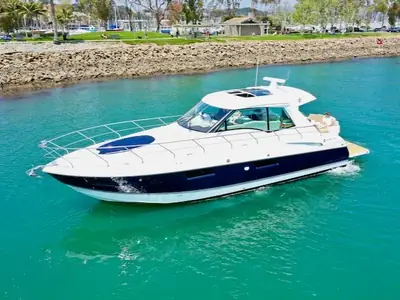
The second reinvention is the one you can actually buy. In 2011 the yard launched the 48 Cantius, and the idea in it was that a cruiser this size should stop being a corridor of separate rooms: two saloons on different levels joined by an open stairwell, the helm and the wet bar and the dinette all in one socially connected space, glass overhead and down the hull sides, and pod drives instead of shafts so the machinery could go aft and the accommodation forward. Power & Motoryacht's tester predicted at the time that it would set the trend for years, and reviewers going back over it since have counted half a dozen boats from other yards that took the same shape. That is the house style now, and it is why the brand was worth buying: MarineMax paid $63 million for the builder in May 2021 and said plainly what it was buying — sixteen models from 33 to 60 feet, filling the hole Sea Ray had left in American-built sport and flybridge yachts when it dropped its larger boats in 2018. The retailer bought the factory.
The hull that started all of it is the one on our shelf:
The honest notes on a modern Cruisers are not really about the boat, they are about what is under it. Pods bought this yard its layout, and they are the most expensive thing a used buyer of one can misjudge. PassageMaker, comparing pods and shafts without a dog in the fight, put routine annual pod maintenance — oil, anodes, antifouling — at around $2,500 against roughly $100 of anodes on a conventional inboard, noted that the work needs tools and training most yards do not have, and reported that a grounding which shears a pod off runs into five figures. Owners and technicians on the forums are blunter about the specific failure: the shaft seals want replacing on a drive more than about five years old and the water level watching thereafter, because seawater into a first-generation drive reaches the clutch plates and turns into a gearbox rebuild, with quoted repair ranges running from the mid five figures upward. Volvo fitted bronze steering seals until 2009, which owners in salt water found failed sooner than expected; there was no recall, and later drives got stainless. None of that is Cruisers' engineering. All of it is the survey list on a Cruisers of this generation, and it is why the freshwater history on a particular hull is worth more than any option on it.
On the boat itself the evidence pulls both ways, which is the useful part. On the powerboat forums a poster who tests laminates for a living reported that samples cut from hurricane-damaged Cruisers were among the best he had seen, with no delamination; a 3750 owner describes a boat that is maintenance-friendly with genuine access to its systems, and several say the factory steps up when something goes wrong. In the same conversation another poster relays a friend's 44 Express: an engine replaced, turbos replaced, stress cracks and voids in the glass, and a bow thruster tube letting water into the bilge — and prospective buyers in the thread query the balsa coring in the hull. Read together they describe a yard that builds a good laminate and then fills it with a great many systems: the thing to survey is not the structure, it is everything that passes through it.
Buy a Cruisers if you want an American-built boat of this size at all — the list of yards still making them is short, which is exactly why it was acquired — and if you can read a drive service history or pay somebody who can. Buy elsewhere if you want simple machinery you can maintain yourself, if the boat will live in salt water without a maintenance record to show for it, or if you need a hull that any yard on the coast can service without a factory-trained technician. The one we hold is the 48 Cantius, and the rest of the motor fleet is on the powerboat shelf.
Models on the shelf
✍︎ Drafted with AI, directed and reviewed by a sailor — our editorial disclaimer.
💬 The scuttlebutt
Nobody has sung out yet — the floor is yours.
Sign in to join the scuttlebutt → — one Google click, and your words count.
Keep reading
- designer Wellcraft
- scout preview Racing sailboats — one question, answered from the whole market
- designer Rapido Trimarans
- niche Racing monohulls
- boat 2008 Sea Ray 260 Sundeck