The designer
Excess Catamarans
0 for sale
Excess is the only catamaran marque whose principal rival is built in the same shed. Groupe Beneteau launched it in 2019 out of the Bordeaux plant that turns out Lagoons, with the explicit job of selling to a customer Lagoon was not reaching — by the brand's own account, eighty-five per cent of Excess buyers are monohull sailors moving to two hulls for the first time, people who arrive wanting the boat to feel like sailing rather than like a house that floats. Everything the marque does follows from that one sentence. Twin wheels aft at deck level instead of a flybridge, with the rudders driven through Dyneema rather than a long run of cable and quadrant, so the helm has something to say. A lower boom and a square-top mainsail. An overlapping genoa where the market standard is a self-tacker. And an optional taller rig — the Pulse Line, which on the largest model adds six feet of mast and a hundred and thirty square feet of upwind sail — offered as the answer to a question no volume cruising catamaran was asking its buyers.
The problem was that the brand arrived before the boats did. The first two models, the 12 and the 15, were Lagoon hulls under new decks, and the trade press said so at once and unkindly; a marque founded on how a boat sails had launched with hulls drawn for a different argument. The yard's own brand director has since put it more plainly than any reviewer did — when the line was first launched, the promise did not match the product — and that admission is the single most useful fact for anyone shopping the used market, because it dates the range. The 11 in 2021 was new from the keels up. The 14 that followed is a VPLP hull with asymmetric sections that push buoyancy outboard and cut the interference drag between the hulls, thinner keels, rudders eight inches deeper and the bridgedeck raised. On this marque the model number is the specification:
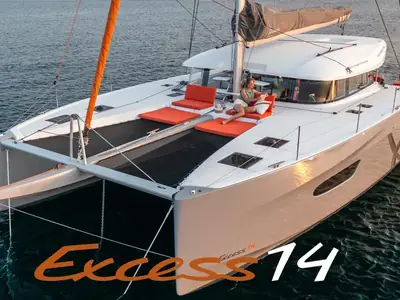
Where the case for and the case against meet is the boat's whole reason for existing. Yachting World's test of the 14 logged seven and a half to eight knots upwind in twelve to fourteen knots of true wind, a delivery crew's sixteen and a half knots at the top end, and a boat that nearly kept pace with a forty-seven-foot monohull in six or seven knots of breeze. The same reviewer wrote that there are more spacious and better finished boats of this size, that the boat falls off quickly if you try to point too high in light air, that it is not a high-performance vessel capable of sustained speeds in the upper teens, and that its closest rivals are two tonnes lighter, faster and arguably nicer to sail. Both halves are accurate, and together they describe exactly what the marque is: a boat beaten on volume and finish by the one built alongside it and beaten on speed by the lighter specialists, sold for less than either. That is a real proposition and a narrow one. A buyer who actually wants one of those two things in its pure form has a better boat available; Excess earns the money only from someone who wants both and will not pay the price of either.
The construction notes are the ones weight-saving always brings. The hulls are vacuum-infused with balsa core above the waterline and in the deck, carbon used selectively rather than throughout, and reviewers noted small economies elsewhere — the hardtop edge left hard instead of rounded to save weight, the non-skid becoming slippery at its edges when wet, no compass at either wheel or at the chart table. The most interesting reservation is aimed at the brand's signature feature: Yachting Monthly, testing the 11, pointed out that the Dyneema steering lines run above the engines, that Dyneema's working temperature limit is around seventy degrees and an engine runs hotter than that, and that the boat carries backup steering for the case where that matters. Nobody has reported it failing. It is nonetheless the one item on this boat where the thing that makes it fun to steer and the thing a surveyor should look at are the same component, and on a young fleet with no long service record behind it, that is where the attention belongs.
Buy an Excess if you came off a monohull, want to steer from the back of the boat with the sheets in reach, and would rather have the taller rig than the bigger fridge. Do not buy one if the brief is the largest saloon per euro, which is Lagoon's answer and a good one, or if the brief is genuine performance, in which case the lighter French yards including Nautitech get there first. And do not buy the badge without the hull number: the boats the marque launched with are not the boats it makes its argument with now. The rest of the two-hulled fleet we hold is on the catamaran shelf.
Models on the shelf
✍︎ Drafted with AI, directed and reviewed by a sailor — our editorial disclaimer.
💬 The scuttlebutt
Nobody has sung out yet — the floor is yours.
Sign in to join the scuttlebutt → — one Google click, and your words count.
Keep reading
- niche Cabin cruisers under $50k
- scout preview How much center console does $100k buy? — a Scout study
- boat 2021 Monterey M-225
- boat 2012 Cruisers Yachts 48 cantius
- boat 2016 Sea Hunt Gamefish 30