The designer
Fountaine Pajot
0 for sale
Fountaine Pajot arrived at cruising catamarans from the wrong end of the sport, and forty years of walking away from that beginning is the house style. The yard was two racing sailors — Jean-François Fountaine, a Half Ton world champion, and Yves Pajot, an Olympic medallist in the Flying Dutchman — moulding 420s, 470s and 505s in sandwich in a family garage near La Rochelle. It went offshore with the trimaran Royale and with Charente Maritime, a twenty-metre racing catamaran that spent the early 1980s winning transatlantics, and only then built a cruising boat: the Louisiane 37 of 1983, drawn by Joubert and Nivelt, about ninety hulls. Everything since has moved in one direction. Each generation carries more volume, more weight and proportionately less sail than the one before, and the yard now owns a monohull builder too, having bought Dufour in 2018. Rupert Holmes, testing the current 41 and 44 for Yachting World, put the trade in one sentence: the modern boats are a lot heavier than the Bahia 46 and Isla 40 that came before them, with proportionately smaller sail areas, and they lose speed quickly if you try to pinch. He also found them solid in 15 to 25 knots, praised the galley island and the new bridgedeck layout, and disliked hydraulic steering with no feel in a quartering sea and the absence of anywhere to keep a watch from.
So a used Fountaine Pajot is not one proposition but two, and both are on the water at once. The older one is the Athena 38, Joubert and Nivelt again, built from the mid-1990s for charter fleets and private owners in roughly equal measure: comparatively light, fine-sectioned hulls, bridgedeck clearance that Yachting Monthly credited for its seaworthiness while rating the boat one of the better performers among the charter-oriented cats of its generation. A used-boat survey published by the German magazine Yacht found a sixteen-year-old hull with no gelcoat cracking, no bubbling and no laminate trouble, and 9.5 to 10 knots under gennaker in fifteen knots of wind — and, in the same piece, forestay sag at the hounds worth five degrees of pointing, a genoa track too short to sheet properly on deeper courses, and aluminium water tanks that oxidise until they clog the pipes and pumps and want replacing in stainless. That last one is a question to ask before an offer, not after:
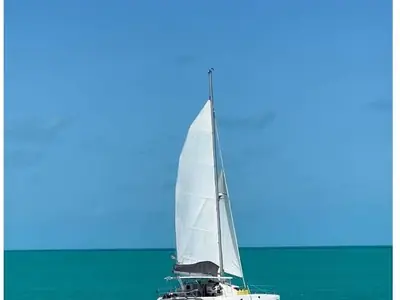
The modern argument is the Hélia 44, which SAIL called as cutting-edge in its own way as a carbon racer and Cruising World found as quick as it is comfortable. The most useful account of one is not a boat test at all: an owner couple who sailed a Hélia 44 around the world, some forty thousand miles at an average of 6.7 knots over the ground, and who wrote that they were never once concerned for the structural integrity of the boat — then listed everything else. The mainsail would not come down above fifteen knots until they added intermediate battens and a slipperier halyard. Hatches and courtesy lights bedded in silicone let salt water into the engine compartments. Deck cleats bent and pulled loose for want of proper backing plates, factory genoa sheets were thicker than the winches and stoppers were rated for, and with no daggerboards under it the boat made leeway and got uncomfortable going to windward above 25 knots. Their verdict was still that they would have the boat again, which is the honest shape of this yard: the hull is rarely the argument, and the fittings around it usually are.
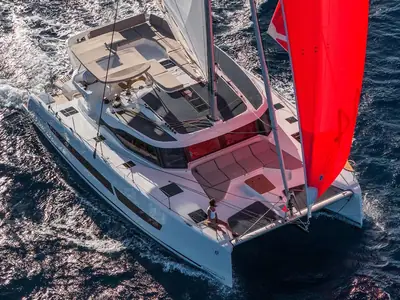
The square metre a survey earns its fee on is under the bridgedeck. Fountaine Pajot moulds shallow sacrificial mini keels rather than daggerboards, and the yard's own explanation is that they are meant to take the hit and break before the hull does. Owners report the other half of that bargain. Yacht's inspection of the Athena found water standing inside the glued-on keel stubs with no drain plug and no inspection hatch to get it out again; a 44-foot Fountaine Pajot documented in a rebuild on the Sail Life channel had water found inside a keel by thermal imaging with nothing visible from outside, and cutting it open showed flotation foam that had never been properly applied; the circumnavigating Hélia owners cracked a port mini keel and attribute it to a beaching on a concrete ramp. All of these can be true at once, and they send the surveyor to the same place with the same instruments — moisture meter and hammer on both keel stubs, and a straight question about what has been done to them and when. A keel designed to be sacrificed is a keel you should assume has been asked to do its job.
Two other things follow the boats rather than the model. Deck fittings on the older hulls leak until they are rebedded, which is a weekend and not a disaster but is worth pricing. And a great many of these boats worked for a living: an ex-charter Fountaine Pajot is a maintenance history in someone else's handwriting rather than a disqualification, and how to read one is the whole subject at the yard that builds for the fleets directly.
Buy one if you want a French production catamaran that sails a little better than its volume suggests and has a parts and dealer network on both sides of the Atlantic — and buy the era that matches the plan, because the older hulls are the sportier ones and the recent hulls are the more comfortable ones. Look elsewhere if the plan is windward work in a breeze, where a daggerboard boat from a performance yard will simply do it better, or if you want a dedicated navigation station. The rest of the two-hulled fleet we hold is on the catamaran shelf, and the boats big enough to have earned their keep in charter are gathered on the charter-size shelf.
Models on the shelf
✍︎ Drafted with AI, directed and reviewed by a sailor — our editorial disclaimer.
💬 The scuttlebutt
Nobody has sung out yet — the floor is yours.
Sign in to join the scuttlebutt → — one Google click, and your words count.
Keep reading
- boat 2007 Centurion Enzo SV240
- designer Nautitech Catamarans
- scout preview What $120k of wake boat looks like — a Scout study
- niche Center consoles under $100k
- boat 1996 Monterey 276