The designer
Gemini Catamarans
0 for sale
The Gemini answers a question the big cruising-catamaran yards never asked: what does a catamaran have to give up to fit the slip, the travel-lift and the budget you already have? Everything else about the boat follows from the answer. The beam is fourteen feet on every model, decade after decade, which is a standard slip rather than the double-width berth cats get charged for, an ordinary marina lift rather than a specialist one, and a boat that can be trucked overland — nearly unique among cruising cats. Under it, twin centreboards that give eighteen inches of draft raised and five feet lowered, which is the difference between reading the Bahamas or the Intracoastal from a chart and reading them from a channel marker. And one engine instead of two, on a steerable leg between the hulls tied into the rudders. Tony Smith, an Englishman who had already built close to three hundred Telstar folding trimarans, started this in Maryland in 1981 after a fire destroyed the Telstar moulds: he took a set of catamaran moulds he already owned, the Aristocat, drawn by Ken Shaw in 1969, and relaunched it as the Gemini 31. What followed — the 3000 and 3200, the 3400, a completely redesigned hull as the 105M in the mid-1990s, then the 105Mc — made this the most-produced cruising catamaran in America.
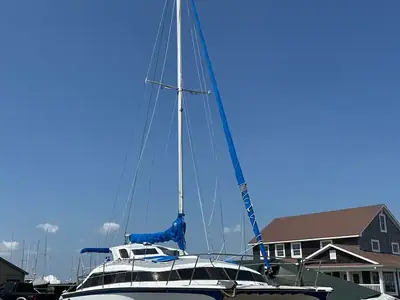
The first generation is still afloat in numbers and still the cheapest door into two hulls anywhere:
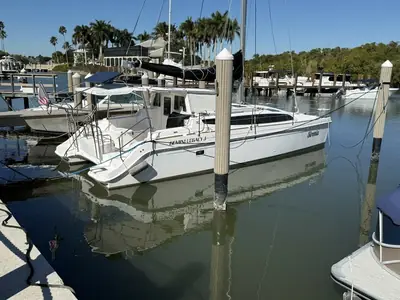
Then the yard died and the boat did not, which is the fact a buyer most needs and the one no brochure carries. The recession pushed Performance Cruising into insolvency; its principal dealer, the Catamaran Company, bought the assets in 2009; the Legacy 35 that followed in 2013 was built under contract at Marlow Hunter in Alachua, Florida, and from September 2014 at Catalina Yachts in Largo. By that year the running total was 1,193 boats, of which the Legacy 35 accounted for 44. So a Gemini is one continuous idea built by three different companies under two owners, and the year on the transom tells you whose hands built it, which parts pipeline stands behind it and whether the factory that made it still exists. The last chapter of it looks like this:
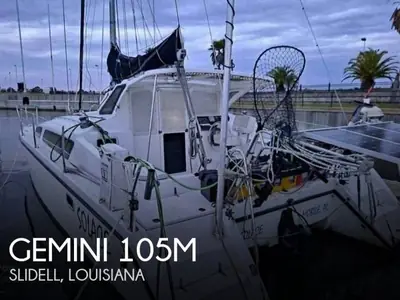
The single engine is where the honest notes start, because it is both the best and the worst thing about the boat. The steerable leg gives a thirty-four-foot cat manoeuvring that owners describe as rivalling boats twice its price — Carolyn Shearlock, who cruised a 105M for years and wrote it up in detail, rates it exactly that way. The same owners are unanimous that the leg is the weak point of the drivetrain, that its steering cables break, and that the Sillette Sonic unit is long out of production with only some parts still available from the UK; repowering, which many boats have now had, means shimming a modern Beta up half an inch or so to meet the Sonic flange. Both accounts are about the same component and they resolve into one instruction: get the leg's history in writing, look for the repower paperwork, and price a rebuild before bidding rather than after. It is a single-screw boat too, so there is no get-home engine and no twin-screw pivot in a crosswind — earlier hulls with the retracting outboard are described as a bear to handle in tight quarters. The generation where all of this is live is the diesel one:
The rest is what light, cheap and shoal costs. With around eighteen inches of bridgedeck clearance the boat pounds in short steep seas and pounds harder loaded; Practical Sailor's test found a bumpy ride and water over the bow in short chop, and put close-hauled speeds in the mid sixes against seven to twelve knots reaching. Windward work degrades as the cruising gear goes aboard, which owners meet by footing off or motorsailing. Pre-105Mc centreboards were marine plywood and rot or delaminate if the paint is not kept up. Roughly a fifth of older owners have reported blistering — vinylester came in with the 3200 — and gelcoat voids, crazing and leaking windows are the standard complaints on the first two decades of hulls. Water has been found migrating into the flotation chambers unnoticed because there were no inspection ports to find it through, and Practical Sailor flagged wiring and plumbing looms moulded into the liner as virtually inaccessible when something inside them fails. That last one is worth weighing properly: it is not a fault that shows on a survey, it is a fault that shows on the invoice for every future repair.
None of this was ever designed around a charter fleet, which is the cleanest way to place the boat against the yards that were. Buy a Gemini to cruise thin water shorthanded, to keep the marina bill at monohull rates, and to own a catamaran for the price of a mid-size sailing boat with an owners' association and thirty years of accumulated fixes behind it. Do not buy one to carry a family's worth of stores across an ocean, to have a second engine when the first one stops, or to get the volume a modern forty-footer offers — the 105 and its sisters are a thirty-four-foot boat that sails like one. What we hold of the fleet sits with the rest on the catamaran shelf.
Models on the shelf
✍︎ Drafted with AI, directed and reviewed by a sailor — our editorial disclaimer.
💬 The scuttlebutt
Nobody has sung out yet — the floor is yours.
Sign in to join the scuttlebutt → — one Google click, and your words count.
Keep reading
- boat 2008 Four Winns Vista 278
- niche Center consoles under $100k
- scout preview How much center console does $100k buy? — a Scout study
- designer Astus Boats
- designer Mako