The designer
MJM
0 for sale
MJM builds powerboats the way its founder used to build sailboats, which is to say it treats weight as the enemy and spends money to remove it. Bob Johnstone had already co-founded J/Boats when he started the company in 2002 and named it for his wife Mary; he hired the naval architect Doug Zurn to draw the hulls and contracted the building to Boston BoatWorks, a shop that had been laminating epoxy composites for decades, and the first 34z went from tooling to launch at the Rockland show in eight months. The laminate is the argument, and the people who describe it are the testers rather than the brochure: Power & Motoryacht and PassageMaker both record wet pre-preg epoxy over E-glass, Kevlar and Core-Cell foam, vacuum-bagged and then post-cured in an oven, which is a boatbuilding method borrowed from racing and rarely paid for in a thirty-foot cruiser.
What that buys shows up as arithmetic. PassageMaker weighed a 36z at 13,100 pounds half loaded, noted the aluminium engine blocks alone taking more than 1,300 pounds out of the stern, and then published the consequence: one gallon an hour at five knots — a thousand miles of range — thirteen gallons an hour at twenty-five knots, which is two miles to the gallon on a boat of this size, and twenty-four at a thirty-three-knot top end. Power & Motoryacht's tester ran a 34z behind a single 440-horsepower Yanmar and found it came onto plane quickly and then held an almost constant running trim, handling tight, light and sporty. The whole downeast idea — a lobster-boat profile with a Carolina flare — is common enough. Doing it at this weight, and getting one engine to move it, is the part nobody else was doing at the price.
Which chapter of the company built a particular hull now matters, because there have been three. Bob Johnstone sold MJM to his son Peter around the turn of the decade; Peter took production in-house to Washington, North Carolina in 2021, away from Boston BoatWorks, on the reasoning that it would cost less and build more, and roughly doubled output; in September 2023 the private-equity firm Saothair Capital Partners bought the company, and Peter Johnstone has since stepped down as president. A hull from the first two decades is a Boston BoatWorks boat, laid up by a contractor that no longer builds them for an owner that no longer owns the company. That is not an accusation about anybody's quality. It is a reason to ask, out loud, who supports the boat you are looking at.
The one on our shelf is from those first years:
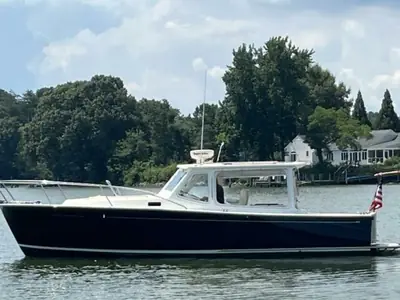
The honest notes have to start by admitting what they are. Nobody has written up what an MJM is bad at, and it is worth being clear about why rather than filling the space: the yard has built a small number of expensive boats sold mostly to one part of one coast, the owners are older and are not forum people, and there is no accumulated public record of failures to read. So what the independent sources fault are limitations rather than defects, and there are real ones. PassageMaker says flatly that this is not a yacht that is going to cross the Pacific, or one on which you can retire and live aboard in the Caribbean, and that the designers rejected the idea of sleeping a crowd on purpose: two permanent berths, settees for a couple more, an eighteen-gallon holding tank and a hundred gallons of water. Brokers talking to Power & Motoryacht describe the boats as very East Coast-ish and soft-sided, a harder sell in the Pacific Northwest, and say that sellers have got to be ready to be realistic and negotiate. Power & Motoryacht's own tester hedged on the looks and thought the topside detailing more utilitarian than some buyers would want — and, to his credit, recorded that his test boat's propeller was still being tweaked and never reached its rated revolutions, which is a caveat on his own numbers.
So this is a couple's boat, bought by people who have done the arithmetic on fuel and decided that a light hull and one engine is the civilised answer. Buy one if that is the trip you actually take — day runs and weekends, fast when you want it, cheap when you do not — and if you would rather have a small beautifully built boat than a big adequately built one. Buy elsewhere if you need to sleep four adults properly, if the boat has to live outdoors on a Pacific mooring rather than under canvas on a New England one, or if you want a brand whose faults somebody else has already found for you. The hull we hold is the 34z, and everything we watch under power is on the powerboat shelf.
Models on the shelf
✍︎ Drafted with AI, directed and reviewed by a sailor — our editorial disclaimer.
💬 The scuttlebutt
Nobody has sung out yet — the floor is yours.
Sign in to join the scuttlebutt → — one Google click, and your words count.
Keep reading
- boat 2008 corsair marine CORSAIR 37
- scout preview Racing sailboats — one question, answered from the whole market
- niche Racing monohulls
- designer Cobalt Boats
- boat 2021 TRICAT 30