The designer
Sea Ray
0 for sale
In 2017 Brunswick put Sea Ray up for sale, and in June 2018 it took the brand off the market and cut the top off it instead. Trade Only Today reported the wind-down of yacht and sport-yacht production beginning that third quarter, as many as 825 positions going, Palm Coast to close as soon as practical and a portion of the Sykes Creek plant kept running — in Brunswick's own words — to support customer service, warranty obligations and other operational requirements. The company's explanation was that the yacht category's persistently weak performance had complicated and obscured the value of everything else with the name on it. Sea Ray had been shipping over two thousand boats a year, three or four hundred of them above forty feet; what survived the decision was the twenty-four to forty-foot business, pointed hard at outboards. So the largest premium powerboat brand in America chose to be a sport boat and cruiser company, and every Sea Ray over forty feet on the water became a boat its builder had decided to stop making.
The second thing to know about this yard is not a hull shape either. Sea Ray sells through a machine. MarineMax, its largest dealer, accounted for more than half of worldwide Sea Ray sales, and Sea Ray in turn made up roughly twenty-three percent of MarineMax's fiscal 2017 revenue — a relationship between one builder and one retailer with very few parallels in the industry. That concentration is the house style, and it explains both halves of the brand's reputation. It is why a Sea Ray is easy to buy, easy to sell and easy to get parts for, and it is why the phrase everyone reaches for when praising the brand — broad dealer support — needs reading carefully, because breadth and concentration are not the same thing.
Our own example is the deck-boat side of that argument rather than the cruiser side, which is where most of the brand's volume actually lived:
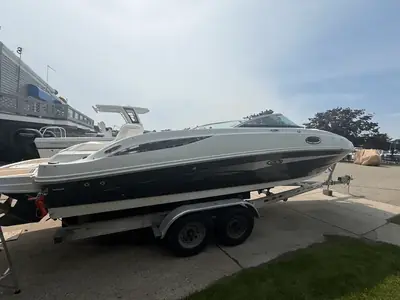
The Powerboat Guide's entry on the 260 Sundeck of that generation is specific about what the yard did differently: a solid fibreglass hull, a trailerable eight-foot-six beam, and slightly more freeboard than a standard deck boat so it stays drier in big water. The praise for the current boats is measured the same way. Boating's certified test of the 2025 SDX 250 with a 300 hp Verado topped 48 mph and found it incredibly manoeuvrable, making hard 180-degree turns in a narrow channel; the testers' own low points were that they would have thought this robust hull rated for more than 300 hp, and that the big locker under the rear sun lounger shares undivided space with the batteries and the fuel tank. A complaint that a hull deserves more power is a compliment with a receipt attached.
What a survey earns its fee on is less flattering and much more specific. Sea Ray's own product support desk, answering an owner on the iboats forum about mid-to-late-1990s boats, said plainly that these would have wooden stringers and wood in the centre of the transom, that it is marine-grade wood, and that the gelcoat should keep water out but if there are voids in the gel water could have got into the wood. A regular in the same thread went further — the design of foam and stringers that Sea Ray used is questionable at best — because flotation foam under the deck holds moisture against the timber, so a wet bilge is not something that dries out again. Notice that the factory and the critic do not disagree about a single fact. They disagree only about whether it is a design fault or a maintenance one, and that is an argument a buyer is not required to settle: both versions end at a moisture meter.
A surveyor writing about this brand turns that into a list by model. Soft foredecks around the windlass on the 260 and 280 Sundancer; moisture at the radar arch bases and the deck-to-hull joint near the cockpit scuppers on the 300 and 340; stringer-top deterioration on the late-1990s 270s where bilges stayed wet; and on the mid-2000s boats, electronic interface modules that fail intermittently and take the horn, the lights and the windlass with them. The same surveyor's summary of why people keep buying them is comfort, resale appeal and broad dealer support — the three things 2018 put an asterisk beside for one half of the range and left untouched for the other.
That asterisk is the whole of the advice. Below forty feet, buy a Sea Ray if you want the most liquid used boat in American powerboating: a hull with more comparables than any competitor can offer, a dealer network that will still answer the phone, and a resale conversation that is already priced in rather than waiting to surprise you. Above forty feet, understand what you are buying into — a discontinued line supported by a plant kept partly open for exactly that purpose — and price the support question rather than assuming it. And buy elsewhere entirely if you are shopping the nineties and early-2000s hulls without a surveyor, because on this brand the factory itself will tell you there is wood in there. The small end of the fleet is gathered on the bowriders under $50k, and the whole motor fleet on the powerboat shelf.
Models on the shelf
✍︎ Drafted with AI, directed and reviewed by a sailor — our editorial disclaimer.
💬 The scuttlebutt
Nobody has sung out yet — the floor is yours.
Sign in to join the scuttlebutt → — one Google click, and your words count.
Keep reading
- niche Motoryachts $50k–$200k
- designer PDQ
- boat 2013 Corsair Dash 750 MkII #92 ()
- scout preview What $120k of wake boat looks like — a Scout study
- designer Correct Craft