The designer
Wauquiez
0 for sale
Wauquiez is a French yard that spent its first twenty years building English boats. Henri Wauquiez started under licence in 1965 at Neuville-en-Ferrain, inland from Lille and about as far from a shipyard town as France gets, and his taste ran to Kim Holman: the Centurion 32 that sold some 380 hulls, the Amphitrite, the Prétorien 35, with Ted Hood and Britton Chance drawn in alongside Holman & Pye. What that generation of boats has in common is a laminate rather than a look. Charles Doane's account of a Prétorien describes multiple layers of 18-ounce biaxial cloth stiffened by lateral stringers and athwartship beams, an end-grain balsa deck with resin barriers to stop moisture migrating, and fittings both through-bolted and glassed over — the yard's own argument for the lighter cloth being that resin saturates it more reliably than it saturates a heavier one. That is the reputation the badge still trades on forty years later, and it was earned by a company that no longer exists in the form that earned it. Beneteau took the yard into its group in 1997 and sold it to Verdoso Industrie in June 2008; Verdoso went into liquidation in October 2010; in January 2011 Wauquiez landed with the industrial holding Experton-Revollier, where it recovered. Three owners in three years, and the boats built either side of that gap are different boats.
Different in the laminate, specifically. Practical Sailor's test of the Centurion 40S — a Berret-Racoupeau hull from the group era, not a Holman one — describes a resin-infused balsa-cored hull with vinylester in the skin coat, a sandwich deck, a hull-to-deck joint made with polyurethane adhesive and fasteners, and plumbing built to Beneteau's standards with doubled clamps and Jabsco pumps throughout. None of that is a criticism; infusion is a better process than hand lay-up and a cored hull is stiffer for its weight. It is simply not the boat the reputation is about. A hull like this one is the point where the two eras meet:
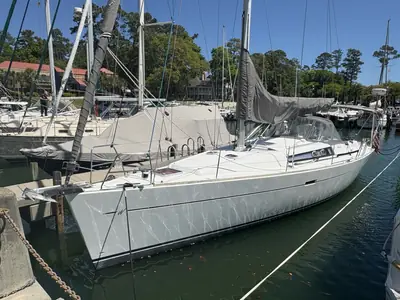
Because the fault list changes with the decade, and both lists are documented. On the older boats Doane reports osmotic blistering in the polyester laminate on some hulls, headstay fittings backed by nothing better than washers where a plate belonged, Volvo saildrive legs corroding, an engine that was underpowered in its original 23hp form and a compartment that is awkward to work in; owners comparing late-1980s and 1990s Centurions on the cruising forums keep returning to bulkhead tabbing and to checking hull and deck for delamination. On the group-era boats the complaints are different in kind. Practical Sailor liked the 40S a great deal — stiff when heeled, responsive, over six feet of headroom, a deck layout organised for short-handed work, and the estimate that she would log 200-mile days — and then listed a saloon table that intrudes on the centreline, an engine cover that has to be removed entirely to reach the engine, handholds it called flimsy and two small portlights doing all the cabin's ventilation. That is a boat let down by fitting-out decisions rather than by its structure, which is exactly the signature of a yard being run for cost inside a large group. Neither list is the other's rebuttal. They tell a buyer which survey to commission: moisture and tabbing on a boat from the first era, coring, systems access and the hull-to-deck joint on a boat from the second.
The yard today is a third thing again — Yachting World's test of the Centurion 57 found a resin-infused sandwich hull with bonded and glassed bulkheads, a single team fitting out each yacht from start to finish, hand sanded teak under seven coats of wax, and a European Yacht of the Year award in the luxury cruiser class, while still complaining that the cockpit is too shallow for offshore work, that the chart table sits awkwardly and that the winch ergonomics fight the traveller. The same tester wondered aloud whether a boat built to reconcile northern and southern European tastes risks satisfying neither. That is a fair worry about a modern Wauquiez and it is also, read backwards, the clearest statement of what the older ones were: boats built for one taste, thoroughly, by a man who liked English yachts. Buy one to get a French cruiser with more structure in it than its length suggests, provided you have read the survey list for its own decade. Buy something else if what you want is the marque rather than the hull — the badge has been owned by four companies and it does not carry the laminate with it. The design our own boat is drawn from is the Centurion 40S; boats bought for the same reasons sit on the bluewater shelf, and everything else we hold on one hull is on the monohull shelf.
Models on the shelf
✍︎ Drafted with AI, directed and reviewed by a sailor — our editorial disclaimer.
💬 The scuttlebutt
Nobody has sung out yet — the floor is yours.
Sign in to join the scuttlebutt → — one Google click, and your words count.
Keep reading
- model Quorning Dragonfly 28
- boat 1996 Monterey 276
- niche Catamarans under $200k
- designer Sea Hunt
- scout preview What $120k of wake boat looks like — a Scout study