The model
Corsair Marine (USA) 36
36.0 ft · 2002–2006 · 4 for sale now
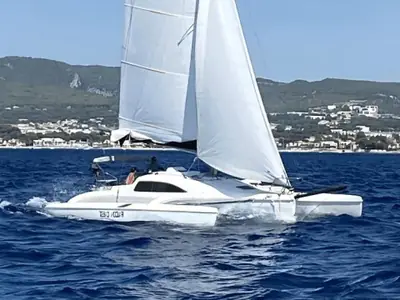
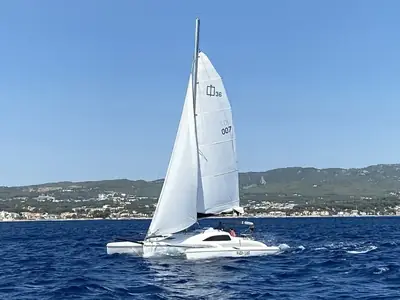
The Corsair 36 is the largest boat the folding idea ever carried at this yard, and the first big one drawn without Ian Farrier. He left Chula Vista in 2000 after falling out with the incoming management, took his own range to New Zealand, and later issued a disclaimer that the 36 should never be called an F-boat or associated with his own F-36; Practical Sailor credits it instead to a team of in-house engineers and outside consultants. What Corsair Marine built is 36 feet and 5,500 pounds of vacuum-bagged foam sandwich with carbon and Kevlar in the crossbeams, flotation built into the hulls, 6 ft 6 in of standing headroom, and a fold that takes the sailing beam down to 9 ft 10 in. Read that last figure twice, because it is a marina number and not a highway number. Sailing World called the boat transportable rather than trailerable, and the distinction is the entire ownership case: the 36 folds to take an ordinary berth and a travel lift, not to follow you home on a Sunday afternoon.
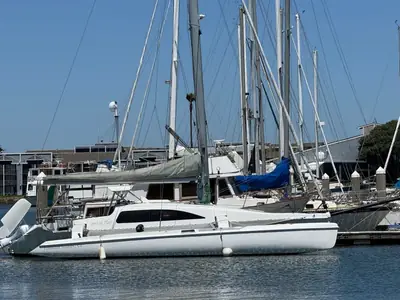
The honest notes are about space rather than speed. Practical Sailor found less elbow room than a 36-foot monohull gives — the main hull is narrow by definition — with stowage at a premium, the ama lockers awkward to reach, and a head just large enough for average-sized adults; the aft double under the cockpit, entered through the lazarette hatches, is the berth the reviewers warned would be ruined quickly by anyone climbing down in wet deck shoes, and Sailing World's tester found that getting in took agility and changing in there took more. The same test found the asymmetric spinnaker a handful. And 5,500 pounds spread over 36 feet makes the payload budget a discipline rather than a suggestion: what you load, you feel. The model was replaced by the restyled Corsair 37, so a run this short is a shopping constraint in itself. Whether a boat that folds can genuinely cross an ocean is a question with its own shelf — the folding trimarans with an ocean record — and it is worth settling before the survey. For the same trick in a boat that really does tow, the 880 is the modern answer; for where the whole idea began, the Corsair 27.
Where the Corsair Marine (USA) 36 is for sale
-
 boat24.comIN THE APP
 -
marinesource.comIN THE APP
-
 rightboat.comIN THE APP
Install the Scout extension and this page shows every live listing for the Corsair Marine (USA) 36 — fetched by your own browser, in your own session. Scout never copies or stores a listing on its servers; it only reads what you fetch, deduped and priced against the Z3stimate.
Add the Scout extensionWhat we hold — open listings
Comparable models
✍︎ Drafted with AI, directed and reviewed by a sailor — our editorial disclaimer.
💬 The scuttlebutt
Nobody has sung out yet — the floor is yours.
Sign in to join the scuttlebutt → — one Google click, and your words count.
Keep reading
- designer Corsair Marine
- boat 2023 Sun Tracker Party Barge 20 DLX
- boat 2003 Catalina 310
- scout preview What $120k of wake boat looks like — a Scout study
- niche Motoryachts $50k–$200k