The model
Corsair Marine CORSAIR 37
37.0 ft · 25.6 ft beam · 2008 · 1 for sale now
The Corsair 37 is the biggest boat Corsair ever asked its folding idea to carry. Everything the brand learned on the trailer-sized F-boats — swing-wing amas, a rig that comes down without a crane, speed as standard equipment — scaled up to a boat with an actual interior and an actual price. It is a restyled, enlarged Corsair 36, drawn after Ian Farrier had left the company and production had moved to Ho Chi Minh City: the yard's own flagship, built on the system he invented. It came in two temperaments — the CR in glass, with the aft cabin and a real shower, and the RS in full carbon, a couple of hundred kilos lighter, for owners who kept the racing itch — and at this size that is not a trim level, it is a different weekend.
Scout watches 3 live askings of the 37; the average sits at $131,920, and what publishes on our shelf runs $118,800 across 2008. The number to distrust in any of them is the model year. Sister hulls of a single season can sit tens of thousands of dollars apart on this design, and the reasons are legible once you know to look for them: a carbon RS and a glass CR are not the same boat at the same age; sails, trailer and electronics were options rather than equipment; and a 37 whose beams have been opened and signed off is worth real money over one whose paperwork stops at the last antifoul. That is how to read a single asking price — against what the fleet is asking and against what a surveyor would find, never against the year in the advertisement. The one we hold the full file on is where to start:
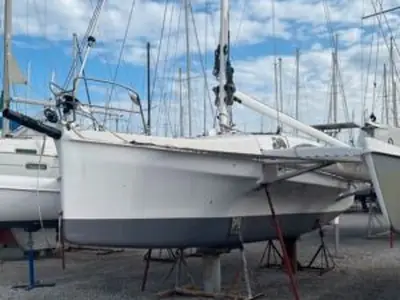
photo & listing at the broker ↗
The flaws begin where the boat's whole idea lives. Folding hardware that carries a 37-footer's loads is exactly where a survey earns its fee — beams, pins and the bulkheads they land on, before anyone opens a locker or admires the upholstery. On this generation, owners and inspectors writing on the multihull forums have reported the internal supports for the forward folding struts delaminating from the hull beside the forward beam; a Corsair dealer answering in the same threads put the cases at a handful across the yard's history, repaired at the builder's expense and designed out of later hulls. Both accounts can be true at once, and both send the surveyor to the same square metre. The reviewer who sailed a CR for the Australian press came away with a cruiser's shopping list rather than a sailor's complaint — an eight-amp alternator, cleats too small for the loads, no bow roller — which tells you which half of cruiser-racer the yard finished first.
The interior, roomy for a folding trimaran, is still narrow company for a monohull sailor's eye: six will sit around the table, but a hull that has to stay a hull cannot hold what a 37-foot catamaran holds, and the finish is what reviewers politely call functional. The fold is less free than the brochure implies, too — swung in, the amas sit with their outer topsides in the water, so most owners leave the boat spread for the season and treat folding as a haul-out and delivery trick rather than a nightly habit. Even the dating is loose: sources put the model's first year at 2008 and at 2009, hulls advertise both, and the real one comes off the plate rather than the listing. The yard's current thinking one size down is the Corsair 880; the boat the whole folding patent was built around is the Corsair 27; the yard's story lives at Corsair Marine, and the rest of the fleet at the trimarans for sale.
On the market
Comparable models
✍︎ Drafted with AI, directed and reviewed by a sailor — our editorial disclaimer.
💬 The scuttlebutt
Nobody has sung out yet — the floor is yours.
Sign in to join the scuttlebutt → — one Google click, and your words count.
Keep reading
- niche Bluewater sailboats
- designer Pogo Structures
- scout preview How much center console does $100k buy? — a Scout study
- designer Solaris Catamarans
- boat 1983 Gemini Catamarans GEMINI 31/3000